


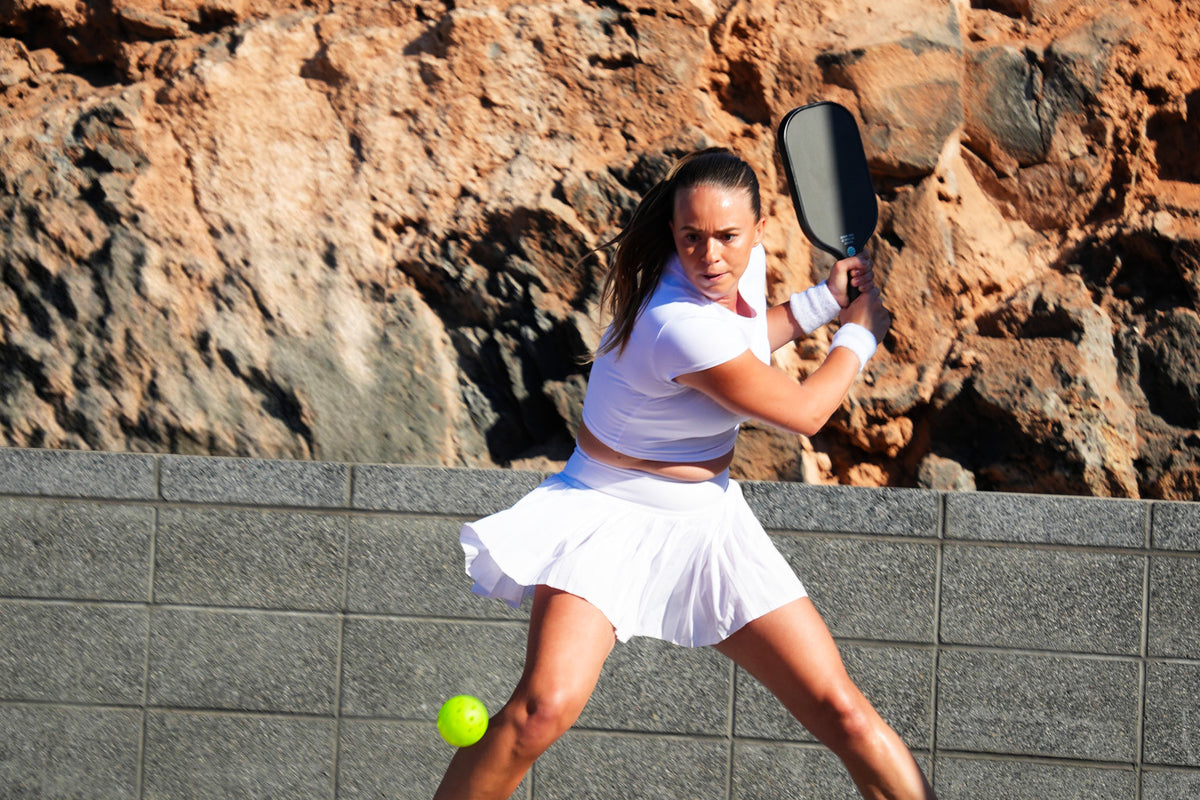
Quick answer: Pickleball is played on a 20 by 44 foot court with a solid paddle and a plastic ball with holes, while tennis uses a court 78 feet long, a strung racquet and a ball with a fabric cover. Pickleball serves underhand, makes both sides let the first two shots bounce and bans volleys within 7 feet of the net, so more of its points are won with placement and soft shots than with pace from the baseline. Tennis players bring their footwork and their swing, and the soft game at the net is the part they have to learn.
Pickleball vs tennis is a comparison most tennis players make the first time they walk onto a pickleball court. The two sports share a net, a serve and a rally, and much of the movement feels familiar. The court, the serve, the scoring and the ball are all different, though, and together they change how points are won. This guide compares the two rule by rule and then looks at what carries over for a tennis player taking up pickleball.
The court and the net
A pickleball court measures 20 by 44 feet, and singles and doubles use the same court. A tennis court is 78 feet long and 27 feet wide for singles, widening to 36 feet for doubles, so a doubles pickleball court covers less than a third of the area of a doubles tennis court. Every ball arrives sooner, and players spend more of the point close to the net.
The nets are closer in height than most people expect. A pickleball net stands 34 inches at the center and 36 inches at the sidelines, while a tennis net is 36 inches at the center and 42 inches at the posts. The ball has to clear nearly the same height in the middle of the court, over a much shorter distance.
The kitchen at the net
The rule with no tennis equivalent is the non-volley zone, which players call the kitchen. It extends 7 feet from the net on each side, and a player may not hit the ball out of the air while standing in it. A tennis player who closes on the net to put away a volley would be breaking the rule in pickleball, so the net game works differently.
Players hold their position at the kitchen line and trade soft shots that land inside the zone, called dinks, until someone hits a ball high enough to attack. Those exchanges ask for touch and patience more than pace.
The serve and the two-bounce rule
A tennis server releases the ball by hand and strikes it before it hits the ground, usually overhead, and gets a second service after a fault. A pickleball serve is underhand. On a volley serve the paddle must move in an upward arc, the paddle head must stay below the wrist, and contact must come no higher than the waist. A drop serve lets the ball bounce first. Either way the serve travels diagonally and must land beyond the kitchen, and there is no second attempt, since the server keeps serving only until their side loses a rally.
The two-bounce rule then shapes the start of every point. The receiving side must let the serve bounce, and the serving side must let the return bounce, before anyone may volley. Serve and volley, a familiar tennis pattern, is not available, and the serving side usually has to earn its way forward with a soft third shot.
Scoring
Tennis scores points as 15, 30 and 40, with deuce and advantage when the game is level at 40. Games make up sets of six with a two-game margin, and a tie-break settles a set at six games all when the event uses one.
Pickleball games are shorter and simpler to count. Under standard scoring only the serving side can win a point, and a game usually goes to 11, won by 2. Tournaments also play single games to 15 or 21. Some events use rally scoring, a provisional option in which a point goes to whoever wins each rally. Our guide to pickleball scoring covers how the score is called in singles and doubles.
The equipment
A tennis racquet is strung and may be up to 29 inches long. A pickleball paddle has a solid face with no strings, and the rules cap its length at 17 inches and its length plus width at 24 inches, with no limit on weight. The pickleball itself is a light plastic ball with holes, which slows down quickly after it leaves the paddle and rewards placement over raw speed.
Without strings, the paddle's face and core decide how the ball comes off it. That is why two paddles that look the same can play very differently, and why the choice of core matters more than many tennis players expect.
Is pickleball easier than tennis?
Pickleball is easier to start. The smaller court, the underhand serve and the slower ball let new players keep a rally going sooner than tennis usually allows, and our complete beginner's guide covers the rules a new player needs.
It gets harder at the kitchen line. The soft game of dinks, drops and resets takes touch that tennis rarely trains, and it takes longer to learn than the drive or the serve.
What carries over for tennis players
Footwork, the split step and the habit of reading an opponent's contact all transfer with little change. A tennis forehand becomes the pickleball drive with a shorter backswing, and players who hit topspin will find it here too. A two-handed backhand carries over as well, as long as the paddle's handle leaves room for both hands.
The habits to adjust sit at the net. Shorten the swing inside the kitchen line, let the return bounce when your side served, and resist stepping into the kitchen to finish a volley. Practicing dinks and resets first works on the part of the game that tennis does not train.
Where we land
For a tennis player buying a first paddle, our guide to the best pickleball paddle for tennis players goes through handle length, swing weight and grip in detail. In our line the choice usually comes down to two elongated paddles with a 5.5 inch handle, which leaves room for a two-handed backhand.
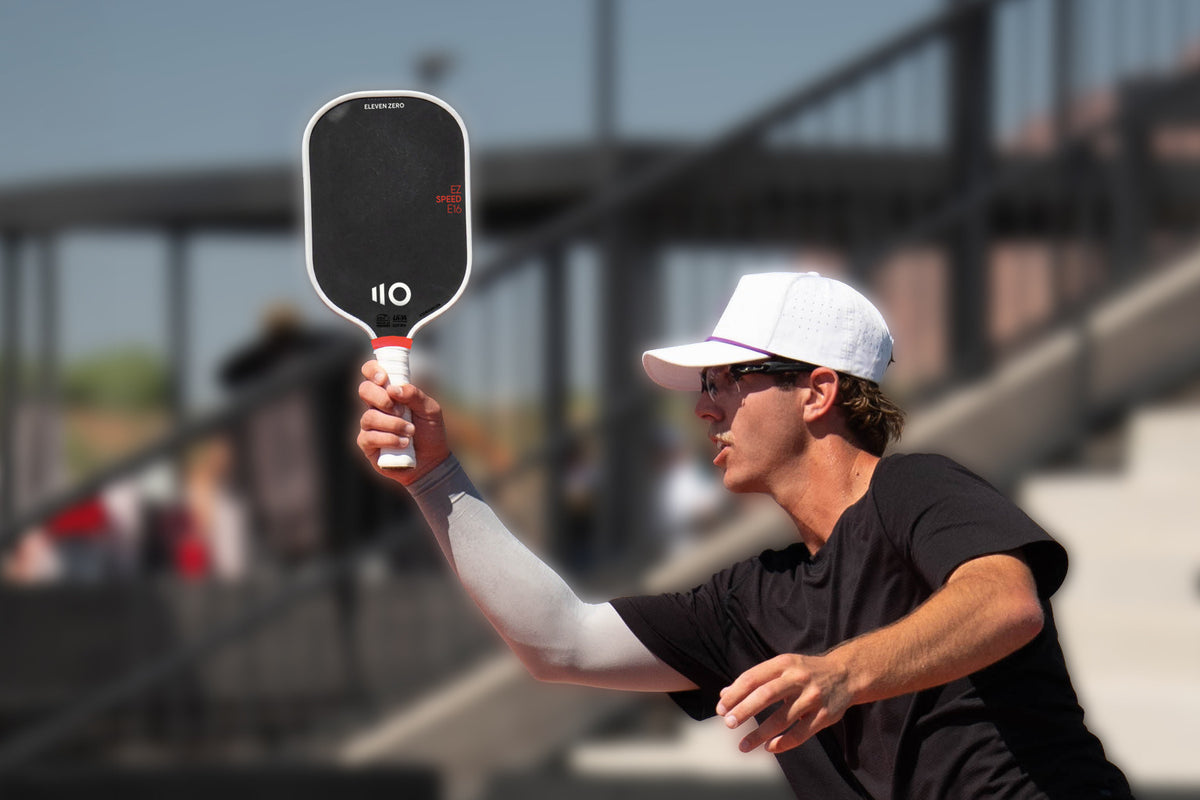
The EZ Speed E14, our elongated 14mm paddle, is the one we suggest for players still building their soft game, because it hits softer and resets more easily, and it is approved by both UPA-A and USA Pickleball. The EZ Speed E16, our elongated 16mm paddle, suits the player who wins with drives and wants more stability and power behind them, and it is approved by UPA-A, so a player entering USA Pickleball sanctioned events should choose the EZ Speed E14.
Tennis gives you the legs and the swing, and pickleball asks you to add patience at the net.
Frequently asked questions
What is the difference between pickleball and tennis?
Pickleball is played on a 20 by 44 foot court with a solid paddle, a plastic ball with holes and an underhand serve, while tennis uses a 78 foot court, a strung racquet and a serve usually hit overhead. Pickleball also has a 7 foot non-volley zone at the net and a two-bounce rule, so its points are won more often with soft shots and placement.
Is pickleball easier than tennis?
Pickleball is easier to start, because the smaller court, the underhand serve and the slower ball let beginners rally sooner. It is hard to master in its own way, since the soft game at the kitchen line takes touch that tennis rarely trains.
Is a pickleball court the same size as a tennis court?
No. A pickleball court measures 20 by 44 feet for both singles and doubles. A tennis court is 78 feet long and 27 feet wide for singles or 36 feet wide for doubles, so a doubles pickleball court covers less than a third of the area.
Is the net the same height in pickleball and tennis?
Nearly, in the middle. A pickleball net is 34 inches high at the center and 36 inches at the sidelines. A tennis net is 36 inches at the center and 42 inches at the posts.
Do tennis skills transfer to pickleball?
Many do. Footwork, the split step, the forehand and a two-handed backhand all carry over. The skill tennis players usually need to build is the soft game at the kitchen line, where dinks and resets win more points than pace.

Share:
Best Pickleball Paddles for Women: How to Choose by Fit