


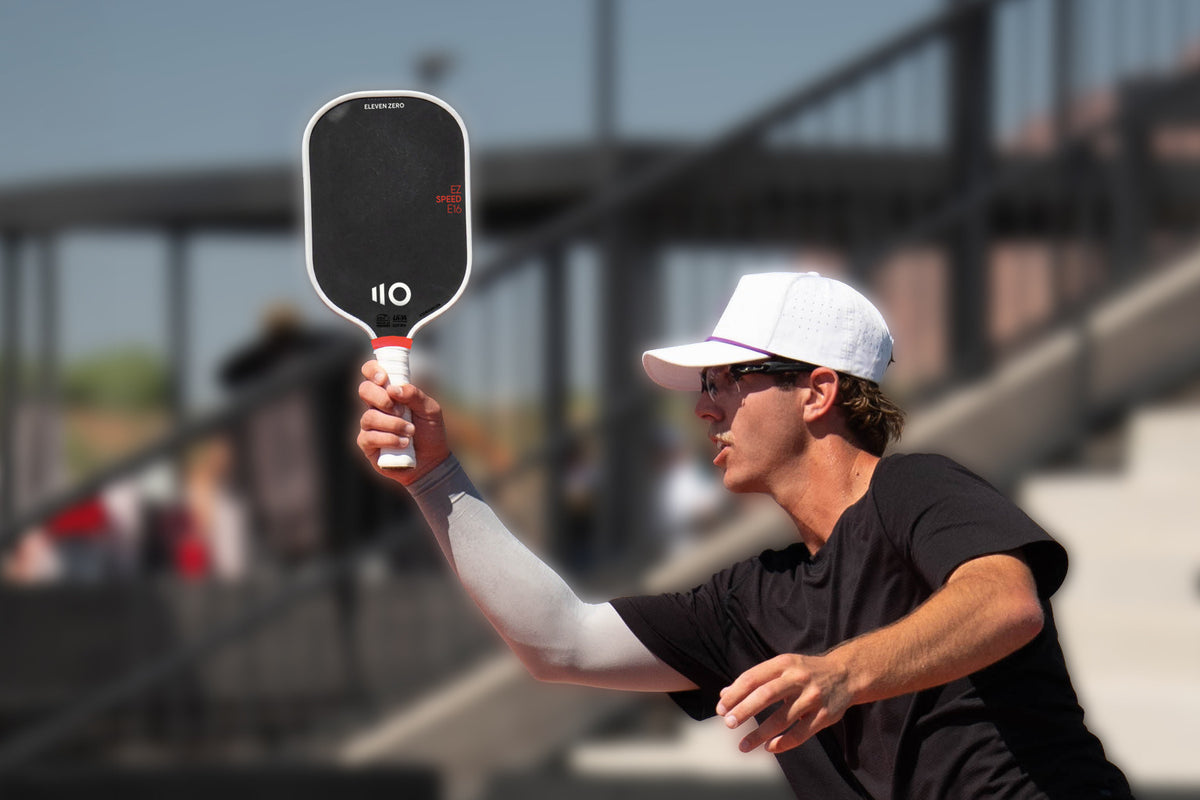
Quick answer: The best pickleball paddles for power pair a swing weight you can still swing at full speed with a core built to return energy to the ball. Every approved paddle sits under the same power limit, so the useful question is how easily a paddle gets to that ceiling and whether it stays there. Thickness only predicts power once you know the core, and on an EPP foam core like ours the 16mm is the more powerful build. In our line the power pick is the EZ Speed E16, our elongated 16mm paddle.
Players shopping for pickleball paddles for power usually want the same two things: a drive that arrives heavy and deep, and a put-away that ends the point on the first swing. Nearly every product page promises both, so the label tells you very little. Knowing where pace actually comes from tells you much more, because a paddle can add to your swing in only a few ways, and the rules limit how far any of them can go.
Your swing supplies most of the pace
A paddle multiplies the speed you bring to it. A full, relaxed drive with the face moving fast at contact will usually beat a short swing with a livelier paddle, which is why the first question for a power player is whether a paddle lets them swing freely. A paddle that feels heavy in motion slows the swing, and the slower swing can cost more pace than the paddle adds.
That makes swing weight the most useful number on the sheet for a power player. It measures how heavy the paddle feels in motion, and it rises as mass sits farther toward the tip. A higher swing weight carries more momentum into the ball and drives harder, while a lower one gets the face around sooner when the ball comes back fast. The right number is the highest one you can still swing at full speed late in a long match. Our guide to reading a paddle spec sheet explains how swing weight differs from the static weight printed on the box.
Mass adds stability and a little power
A heavier paddle carries more momentum through contact, so it holds its line against a hard-hit ball and adds a little power to your own drives. The cost is hand speed, since every gram you add has to move in a fast exchange at the kitchen line. Players who want more drive from a paddle they already like can add lead tape, and tape at the top of the head raises swing weight the most for each gram. Our guide to adding weight to a pickleball paddle shows what each position changes.
The core decides how thickness plays
Most power advice says a thinner paddle hits harder. That rule comes from polymer honeycomb cores, where a thinner core tends to be the livelier one and a thicker core tends to play softer. On an EPP foam core, which our EZ Speed paddles use, the direction reverses. The 16mm is the more powerful build, with a plush and stable contact, while the 14mm hits softer and resets more easily. Paddles with an MPP foam core tend to sit nearer the honeycomb pattern. Read the core material before the thickness, and our 14mm vs 16mm guide goes through each core in turn.
Face material matters less than most listings suggest. Carbon fiber and fiberglass faces produce very similar power, so a paddle that feels poppier usually owes it to the core and the way the paddle is built rather than to the face layer on top.
The rules set the ceiling
Every approved paddle sits under a power limit. USA Pickleball measures how much speed the ball keeps when it rebounds off the face, using a test called PBCoR, and since November 1, 2025 a paddle must read 0.43 or less to be approved. UPA-A tests power as well. It requires production paddles to stay within 10 percent of the samples it certified, and it re-tests paddles after a destructive break-in, so the limit has to hold over the paddle's useful life. Paddles above either limit are rejected.
Among approved paddles, the real differences are how close a paddle sits to the limit and how long it stays there. We build the EZ Speed line right up to the legal limit for power and engineer it to hold that level through the UPA-A re-test, so the pace you feel in your first match is the pace you have months later.
What power asks of you
The pace a paddle adds to drives is also there on soft shots. A lively face sends a reset deeper than you meant and turns a firm block into a ball that travels past the baseline, so a power paddle asks for a lighter touch at the kitchen line. Players who still lose points on resets usually gain more from a paddle that keeps the ball short, and our guide to pickleball paddles for control covers that side of the choice.
How to test a paddle for power
- Drive at 70 percent. From the baseline, hit 20 drives at a relaxed pace and watch where they land. A paddle with real power gives you depth without a full swing, and the number that land in tells you whether you can control that depth.
- Put away a high ball. Have a partner feed 10 balls at shoulder height near the kitchen and count how many end the point on one swing.
- Block a hard drive. Let the partner drive at your body from the baseline. The face should hold its line on the block, and the extra pace should not send your blocks long.
- Count your resets. Hit ten resets from the transition zone and count how many land in the kitchen, then run the same count with your current paddle. The gap between the two counts is the price of the extra pace.
- Check the approved list. Confirm the paddle is approved for the events you play, because tournaments accept USA Pickleball approval, UPA-A approval or both depending on who sanctions them.
Where we land
Every EZ Speed paddle shares one triple-density foam core, an EPP center for energy, a soft EVA layer for feel and a hard edge foam for stability, under a face of carbon fiber over fiberglass over carbon fiber. On that core the thickness and the shape decide how much pace a paddle gives you.
The EZ Speed E16, our elongated 16mm paddle, is our power pick. It measures 16.5 by 7.5 inches, weighs 8.0 ounces and has a swing weight of 114, and its 16mm core gives more pace than our 14mm paddles with a plush, stable contact. It is approved by UPA-A, the standard the PPA Tour runs on, so a player entering USA Pickleball sanctioned events should choose one of our dual-approved paddles instead.
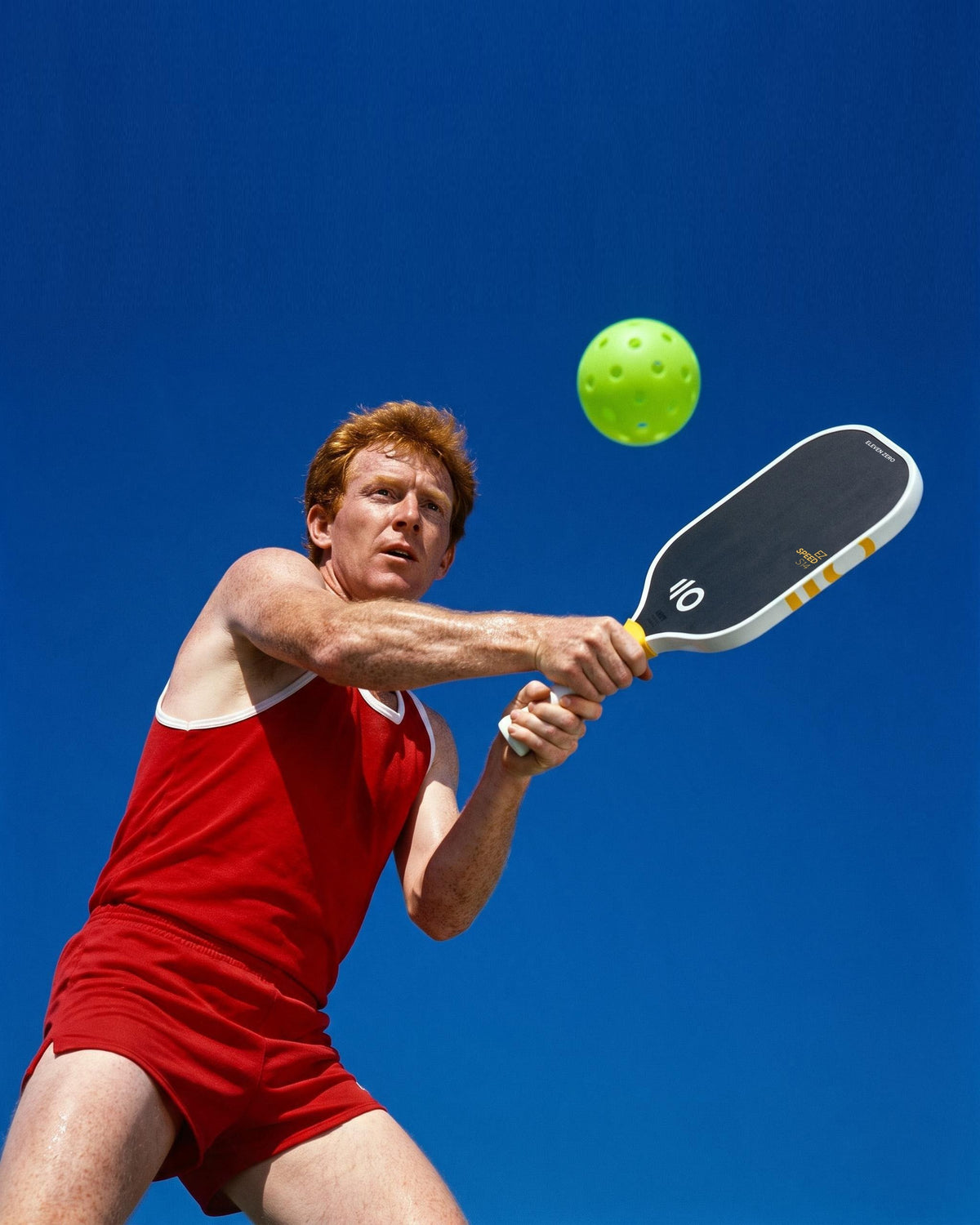
The EZ Speed E14, our elongated 14mm paddle, has the same face size and swing weight with a softer contact, so it trades some pace for easier resets and quicker counters, and it is approved by both UPA-A and USA Pickleball. If resets are where you lose points, the EZ Speed S14, our widebody paddle, has the most stable face in our line and is also approved by both bodies.
Paddles bought on our site come with a 30-day risk-free trial. Drive with one in real matches, and if it does not suit your game, exchange it for another model or return it for a full refund.
Every approved paddle answers to the same ceiling, so choose the one that gets you there on a swing you can repeat.
Frequently asked questions
What is the best pickleball paddle for power?
The best paddle for power pairs a swing weight you can swing at full speed with a core built to return energy, and it holds that pace over its useful life. In our line that is the EZ Speed E16, our elongated 16mm paddle, which is approved by UPA-A. Players at USA Pickleball sanctioned events can choose the dual-approved EZ Speed E14, our elongated 14mm paddle.
Do thicker pickleball paddles have more power?
It depends on the core. On polymer honeycomb, a thinner core tends to be livelier and a thicker core tends to play softer. On EPP foam the thicker core is the more powerful one, so a 16mm foam paddle hits harder than a 14mm foam paddle. Paddles with an MPP foam core tend to sit closer to the honeycomb pattern.
Does a heavier pickleball paddle hit harder?
A heavier paddle carries more momentum into the ball, so it adds a little power and holds its line better on blocks. Swing weight matters even more for drives, because it measures how heavy the paddle feels in motion. The cost of extra weight is hand speed in fast exchanges at the kitchen line.
Is there a limit on how powerful a pickleball paddle can be?
Yes. USA Pickleball approves only paddles that read 0.43 or less on its PBCoR rebound test, a limit in force since November 1, 2025. UPA-A also tests power and re-tests paddles after a destructive break-in. Paddles above either limit are rejected, so every approved paddle sits under a ceiling.
Should beginners use a power paddle?
Usually not as a first paddle. Newer players lose many points on unforced errors, and a lively face makes soft shots harder to keep short. A paddle with a stable face and manageable pace, such as the EZ Speed S14, our widebody paddle, keeps more balls in play while the soft game develops.

Share:
Pickleball Paddles for Control: What Actually Creates It