



Quick answer: It depends on the core. In a polymer honeycomb paddle, the 14mm tends to have more pop and power and the 16mm more touch and control. In an EPP foam paddle it flips: the 16mm is plush, stable and more powerful, and the 14mm hits softer, resets easier and counters quicker. MPP foam sits closer to the honeycomb pattern.
If you’re comparing 14mm vs 16mm pickleball paddles, two millimeters of core decide how hard the ball comes off the face, how steady the paddle stays when the pace picks up, and how easily you can take pace off a ball at the kitchen line.
Which way each of those goes depends on what the core is made of. Most 14mm vs 16mm advice was written about polymer honeycomb, and it still holds for honeycomb. Expanded polypropylene (EPP) foam runs the other way, because in EPP the extra depth adds power. So find the core on the spec sheet first, then read the thickness.
The three cores you will see
- Polymer honeycomb: a grid of thin polypropylene cells. Light, crisp and predictable.
- EPP foam (expanded polypropylene): foam beads fused in a mold. It plays solid and connected, and makers tune it through density.
- MPP foam (microcellular polypropylene): one continuous structure full of tiny gas cells. It plays springier than EPP and damps vibration well.
14mm vs 16mm in each core
|
Core |
14mm |
16mm |
|
Polymer honeycomb |
Crisp, more pop and power on short swings |
More touch, easier dinks and resets |
|
EPP foam |
Softer, easier resets, quicker counters, more feedback |
Plush, stable, more power from the same swing |
|
MPP foam |
Firmer, more immediate on counters |
More connected and controlled |
MPP is the newest of the three and fewer paddles come in both thicknesses, so its row is a tendency from how makers describe their 14mm and 16mm versions. Test before you trust it.
Should I get a 14mm or 16mm paddle?
Start with the points you lose, then pick the thickness that fixes them in your core.
In honeycomb
- Choose 14mm if you win with speed-ups, counters and punch volleys and want a crisp response
- Choose 16mm if you want easier dinks, drops and resets and a calmer feel at the kitchen line
In EPP foam
- Choose 14mm if you reset a lot, win with quick counters and like more feedback on contact
- Choose 16mm if you want more pace on drives, serves and speed-ups and a plush, stable face, and you have the soft hands to manage that power on resets
Best rule: if you lose points on resets, go to the softer option in your core, which is 16mm in honeycomb and 14mm in EPP. If your drives and attacks do not finish the rally, go the other way.
To compare thickness in the same elongated frame, look at the EZ Speed E14 and the EZ Speed E16.
What thickness does the same in every core
1) Stability and forgiveness
The 16mm tends to stay calmer in fast exchanges in honeycomb, EPP and MPP alike. A face that holds steady on hard-hit balls also holds its angle better when you miss the middle, so most players feel a bigger sweet spot on the thicker paddle.
Weight placement matters as much as thickness here: some players make any paddle steadier on mishits with a little tungsten tape at the sides or an extra layer of overgrips.

2) Feel and vibration
The thicker core feels plusher and passes along less vibration. The thinner core gives you more feedback from every contact.
3) Hand speed
You’ll hear that 14mm is faster in the hands. Most of what players call speed comes from weight and balance. Our EZ Speed E14 and E16 share a swing weight of 114, and the E14 is still the quicker of the two on counters, so test the feel in a real firefight before you trust any spec line.
Where the core flips the answer
Two words get mixed up here. Pop is fast rebound on short swings (speed-ups, counters, punch volleys), and power is pace on full swings (drives, serves, overheads).
Drives, serves and speed-ups
- Honeycomb: the 14mm has more built-in pop. The 16mm can still hit hard, but more of the pace comes from your swing
- EPP foam: the 16mm is the stronger core, and the ball leaves with more pace for the same swing. On the 14mm you supply more of it
- MPP foam: makers describe the 14mm as the quicker, more immediate paddle on aggressive swings
Resets, dinks and drops
Whichever paddle sends the ball off faster also sends your resets faster unless your hands absorb it.
- Honeycomb: the 16mm holds the ball a fraction longer, so soft shots stay low with less effort
- EPP foam: the 14mm takes pace off the ball more easily, and the 16mm asks for softer hands
- MPP foam: the 16mm is the more controlled of the two
Blocks at the kitchen line
- Honeycomb: the 16mm gives the calmer block. The 14mm sends a firm block back with more pop
- EPP foam: the 16mm is steady against hard hitters and sends the ball back with pace. The 14mm gives softer blocks that die closer to the net
Doubles vs singles: which thickness fits better?
Doubles
Doubles is played at the kitchen line, so the deciding question is what you do there. If your game is resets, dinks and counters, take the softer option in your core: 16mm honeycomb or 14mm EPP. If you are the partner who attacks and finishes, take the livelier one: 14mm honeycomb or 16mm EPP.
Singles
Singles asks for more full swings: drives, passing shots and deep returns. Players who want the paddle to add pace pick the more powerful option in their core, and a thicker core’s stability helps when you hit on the run.
How this applies to choosing an Eleven Zero paddle (simple path)
We build in two of these cores. Our EZ Speed line uses a triple-density EPP foam core (a dense EPP center, a soft EVA layer and hard edge foam) under a thermoformed carbon face, in both thicknesses:
- EZ Speed E16: plush, stable and powerful, for players who want more pace from their drives and attacks and have the hands to manage it.
- EZ Speed E14: the softer hit, with easier resets, quicker counters and more feedback, for players who win at the kitchen line.
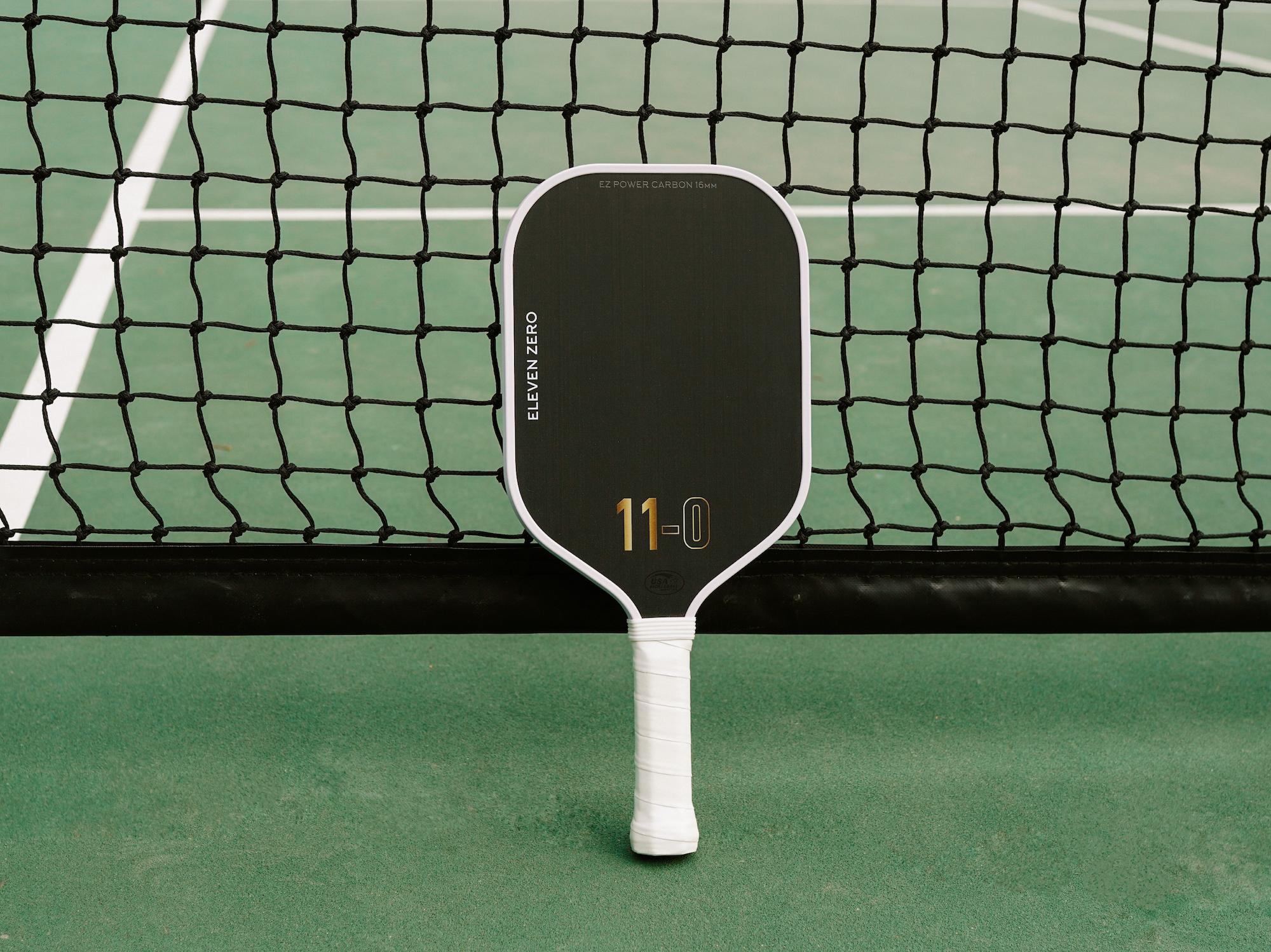
Our honeycomb paddles cover the other side. The EZ Power Carbon 16mm and the EZ Power K-16 are 16mm honeycomb, calm at the kitchen, with 8 grams of endcap weight to drive through the ball. The EZ Pro Origin H13 is 13mm honeycomb, built for power.
Eleven Zero also backs paddles with a 30-day performance guarantee, which is exactly how you should buy a “feel” decision: test it in real games.
Common misconceptions (that cause bad buys)
“16mm always has less power.”
Only in some cores. In honeycomb the 14mm tends to have more pop. In EPP foam the 16mm is the stronger of the two. The core’s material decides which way thickness pushes power.
“Thickness creates spin.”
Spin is mainly influenced by surface and technique. Thickness can change how confidently you brush and shape the ball, but it is not the primary spin dial.
“14mm is always faster in the hands.”
Often the speed people feel is swing weight and balance. Our E14 and E16 share a swing weight of 114, and the E14 still plays quicker on counters, so judge the feel on court rather than the number.
FAQ
Is a 16mm paddle better than 14mm?
Not universally. In honeycomb the 16mm brings touch and the 14mm brings pop. In EPP foam the 16mm brings more power and a plush, stable feel, and the 14mm brings easier resets, quicker counters and more feedback. Pick the one that fixes the points you lose.
Does 16mm give more control?
It gives more stability in every core. In honeycomb it is also the easier paddle for soft shots. In EPP foam the 16mm is the more powerful paddle, so if control means keeping resets and dinks low, the 14mm is easier.
Does 14mm give more power or more pop?
In honeycomb and MPP foam, it tends to. In EPP foam, no: the 16mm has more power and more pop, and the 14mm’s strengths are quicker counters, easier resets and more feedback.
Which has a bigger sweet spot, 14mm or 16mm?
The 16mm feels steadier on off-center hits in every core. Shape and weight placement move forgiveness as much as thickness does, and tape at 3 and 9 o’clock makes any paddle steadier on mishits.
Does 16mm reduce vibration?
It feels plusher on contact, which many players feel as less vibration. Comfort also depends on handle build, edge design and grip setup.
Should I get 14mm or 16mm for doubles?
Pick by your role at the kitchen line and your core. If you win with resets and dinks, start with 16mm honeycomb or 14mm EPP. If you win by attacking and finishing, start with 14mm honeycomb or 16mm EPP.
Also on Amazon. If Amazon is where you prefer to buy, the EZ Speed E16 is listed there with Prime shipping: EZ Speed E16 on Amazon.




Share:
Pickleball Paddle Thickness: 13mm vs 14mm vs 16mm Explained
Choosing a Paddle Based on Your Playing Style