



Quick answer: The best pickleball paddles for control give you a ball you can predict: a face that stays steady when you miss the center, a power level you can manage on a short swing, and a feel that tells you where you made contact. Thickness alone does not decide it, because on an EPP foam core like ours the 14mm is the softer build. In our line the widebody EZ Speed S14 and the hybrid EZ Speed H14 are the control paddles.
Ask a group of players what a control paddle is and most will describe a soft one, a paddle that takes pace off the ball so it stays in the court. Softness is part of the answer. The fuller answer is predictability. A control paddle sends the ball where your swing told it to go, at the pace you chose, on clean contact and on the slightly bad contact that happens many times in every game.
That matters when you shop, because no rulebook measures control. USA Pickleball and UPA-A test a paddle's power, its spin and its surface, so "control" on a product page is a word the brand chose. To buy pickleball paddles for control well, you need to know which parts of a paddle produce it.
What control means on court
Control shows up in the soft shots: dinks, drops, resets and blocks. Each one asks you to take pace off the ball and land it in a small space, often while the ball arrives faster than you would like. A paddle helps when it makes those outcomes repeat. Hit the same reset twice and you should get the same ball twice.
Four properties of a paddle work toward that, and they matter in roughly this order.
A face that holds its line
Many missed resets start with contact away from the center. When the ball strikes near the edge or the tip, the face turns in your hand and the ball leaves at an angle you did not choose. A paddle resists that turn with width and with mass placed toward the edges, and a wider face also gives you more room before you reach the edge at all.
This is why weight helps control more than most players expect. Extra grams at the sides of the head steady the face on blocks and resets, and they add a little power on drives rather than taking any away. Players who strip weight to make a paddle feel quicker often give up the steadiness that held their soft game together. Our guide to adding weight to a paddle shows where tape goes and what each position changes.
Power you can manage
Pace the paddle adds on its own works against you at the kitchen line. A very lively face sends a soft reset deep when you wanted it short, and it turns a firm block into a ball that sails past the baseline. The goal is a power level you can dose with a short swing, so the ball travels as far as you meant and stops there.
Thickness is where most buyers go wrong, because the usual rule only holds for one kind of core. On a polymer honeycomb core, a thicker paddle tends to play softer. On an EPP foam core, which our EZ Speed line uses, the 16mm is the more powerful build, and the 14mm hits softer and resets more easily. Paddles with an MPP foam core tend to sit closer to the honeycomb pattern. Read the core first and the thickness second, and our 14mm vs 16mm guide goes through it core by core.
A paddle can also go too far the other way. If you have to swing hard to get a drop over the net, the bigger swing brings errors of its own. The right level is the softest paddle that still gives you depth on a relaxed stroke.
Feel you can read
Feedback is the information that travels up the handle at contact. A paddle that tells you clearly where you struck the ball lets you correct the next shot, and a long dink exchange is a chain of those small corrections. On our foam core the 14mm gives more feedback than the 16mm, which is one reason it suits players who live at the kitchen line.
Grip on the ball
Surface texture lets you shape a soft shot: a touch of topspin makes a dink dip, and slice keeps a drop low after the bounce. It ranks fourth here because spin cannot rescue a ball that left the face at the wrong angle or the wrong pace. Both approval bodies now limit spin, so the choice is about where a model sits within the legal range. A paddle approved only by UPA-A can carry more grit than a dual-certified one, because USA Pickleball also limits how rough the surface may be.
How to test a paddle for control
- The wall test. Stand a few steps from a flat wall and hit 30 soft forehands and backhands at about net height, which is 34 inches at the center. Count how many come back at the same height and pace without you changing your swing. A paddle with good control gives you a tight group early in the set.
- Miss on purpose. Hit a few blocks an inch toward the tip and an inch toward each edge. The ball should hold its line with only a small loss of pace.
- Reset under pressure. Have a partner drive balls at your feet from the baseline, count how many of your resets land in the kitchen, and run the same count with your current paddle.
- Choke up before you switch. Moving your hand up the handle shortens the lever and often adds touch at the kitchen right away, which tells you whether the paddle or the hold was the problem.
- Compare on the same day. Feel drifts with balls, weather and fatigue, so test paddles back to back in one session. Our guide to testing a new paddle in one session sets out the order.
Where we land
Our control paddles are the two widest EZ Speed models, the S14 and the H14. Every Speed paddle has the same triple-density foam core, an EPP center with a soft EVA layer and a hard edge foam, under a face of carbon fiber over fiberglass over carbon fiber, so the shape and the thickness decide the rest.

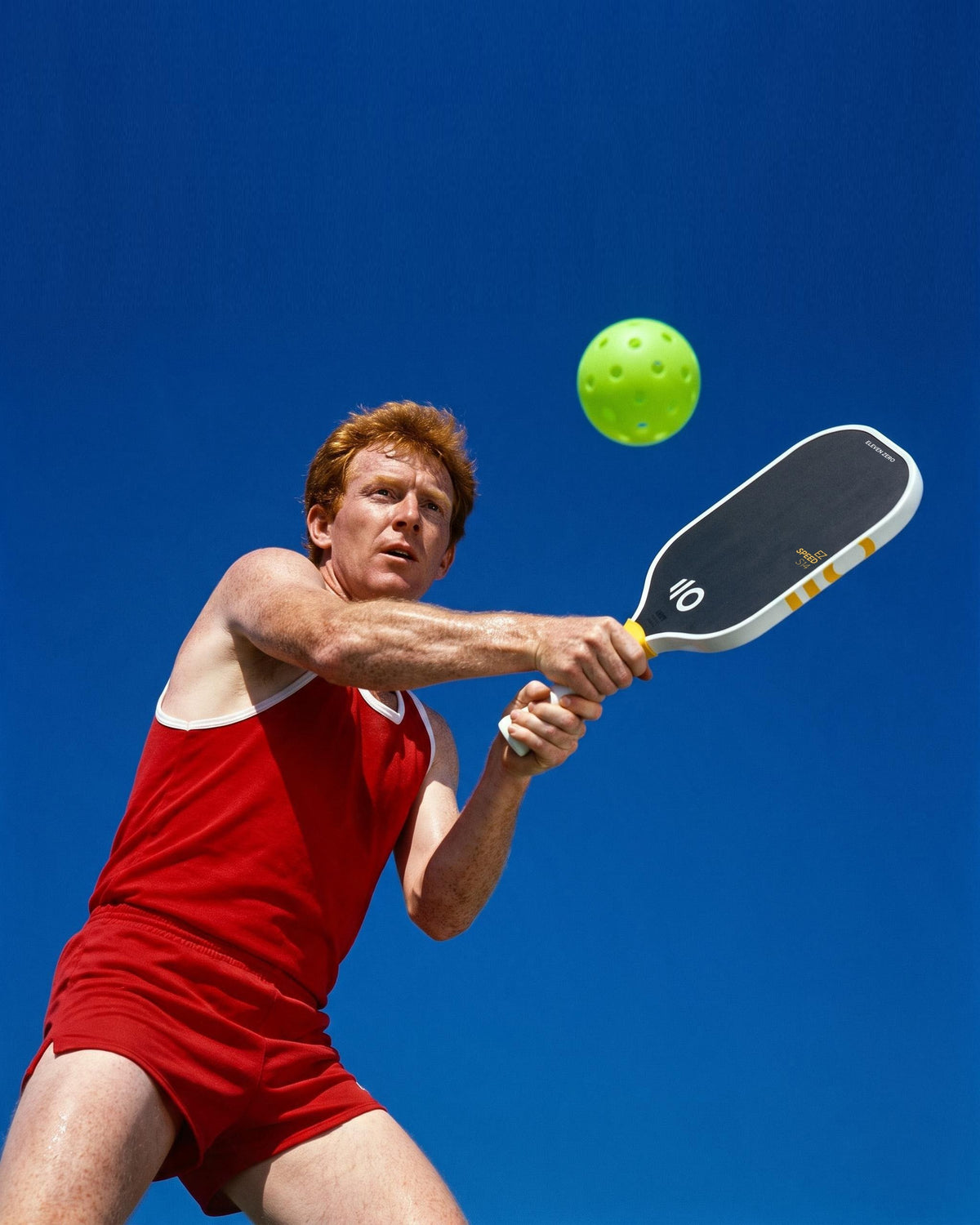
- The EZ Speed S14 is our widebody at 15.9 by 8.1 inches and 8.0 ounces. It has the most stable face in the line and the lowest swing weight, 106, so it stays steady on blocks without slowing your hands. It is the paddle we suggest first to newer players and soft-game specialists, and it is approved by both UPA-A and USA Pickleball.
- The EZ Speed H14 is the hybrid at 16.2 by 7.8 inches and 7.9 ounces, with a swing weight of 111. It sits between the widebody and the elongated shape, keeping much of the S14's steadiness with a longer face, and it is approved by UPA-A.
If you want the standard elongated shape, the EZ Speed E14 hits softer and resets more easily than our 16mm EZ Speed E16, which is the more powerful paddle for players who want more pace on drives and put-aways. Both elongated paddles have a narrower face than the S14 and H14, so for the steadiest face in our line, start with the widebody.
Paddles bought on our site come with a 30-day risk-free trial. Play real matches with one, and if it does not suit your game, exchange it for another model or return it for a full refund. Between two paddles you like, choose the one that keeps more balls in play, since at most levels that wins more points than extra pace.
A control paddle earns the name when your tenth reset of the game lands where your first one did.
Frequently asked questions
What is the best pickleball paddle for control?
The best paddle for control is the one whose ball you can predict, and that comes mostly from a stable face on off-center hits and a power level you can manage with a short swing. In our line the widebody EZ Speed S14 and the hybrid EZ Speed H14 are the control choices, and the S14 has the most stable face of all our paddles.
Are thicker pickleball paddles better for control?
It depends on the core. On polymer honeycomb, a thicker core tends to play softer. On EPP foam the thicker core is the more powerful one, so a 14mm foam paddle hits softer and resets more easily than a 16mm. Check the core material before you read anything into the thickness, and remember that face width does more for stability than either thickness.
Does a heavier paddle give you more control?
Added weight steadies the face, so blocks and resets hold their line better, and it adds a little power rather than taking any away. The cost is hand speed in fast exchanges. Tape at the sides of the head adds stability with less change to swing weight than tape at the tip.
Is a control paddle good for beginners?
Usually, yes. Newer players lose many points on unforced errors, and a steady face with a manageable power level keeps more of those balls in play. The EZ Speed S14 is the paddle we suggest first for newer players, because its wide face is the most stable in our line.
Can you still hit winners with a control paddle?
Yes. A control paddle asks you to supply more of the pace yourself, so put-aways and drives take a fuller swing. Many players find the trade worth it, because a paddle that keeps resets low gives them more chances to attack a high ball.

Share:
Stacking in Pickleball: How It Works and When to Use It