


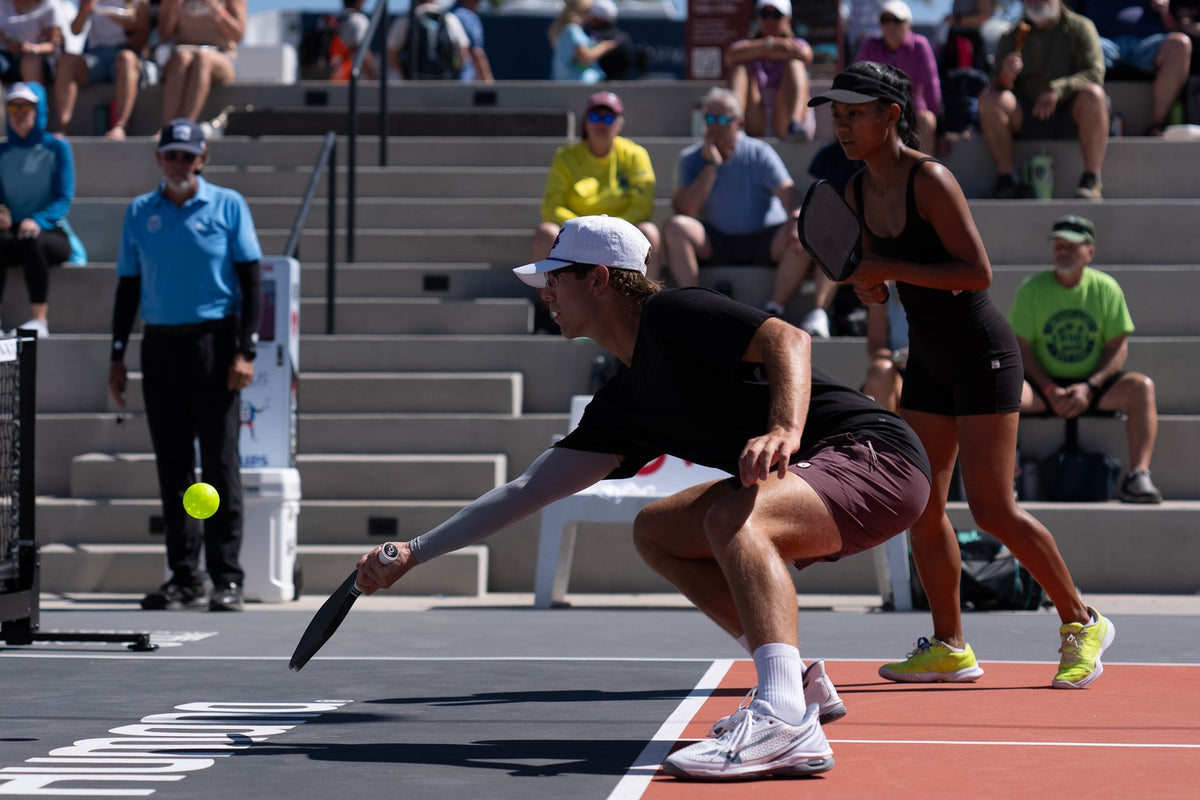
Quick answer: Speed up when the ball is above the height of the net and close enough to hit without reaching, ideally when your opponent's paddle is low or out of position. Aim at the opponent's dominant-side hip or shoulder rather than the open court, keep the swing short, and be ready for the counter, because a speed-up that is not a winner usually comes straight back faster.
Most dink rallies end in one of two ways. Somebody makes an error, or somebody speeds the ball up. As players improve, fewer rallies end on a missed dink and more end on a speed-up, and the player who speeds up first is often the one who loses the point, because an attack hit from the wrong ball hands the opponent an easy counter.
The skill lives in ball selection. How hard you hit matters far less.
What a speed-up actually is
A speed-up is any shot at the kitchen line that changes the rally from soft to fast, usually a short punch or a flick aimed at an opponent rather than past them. Both teams are standing about 14 feet apart, since the non-volley zone runs 7 feet on each side of the net, so a fast ball arrives in well under a second. The exchange that follows is decided by hands and paddle position far more than by footwork.
That speed is why the choice matters. The player who speeds up commits first, and if the ball they attack is low, the shot has to travel upward, which gives the opponent a ball at a comfortable height to counter.
The ball that earns a speed-up
The most reliable cue is height. If the ball is above the top of the net when you make contact, you can hit it flat or slightly downward, and the opponent has to defend a ball coming at their body. If you are contacting the ball below the net, any pace you add has to go up first, and the counter becomes easy.
A few more cues raise the odds. The ball should be close enough to hit without stretching, since a speed-up from a lunge loses both pace and disguise. Your opponent's paddle should be low or off to one side, which happens most often right after they dig out a dink from below their waist. You should also be balanced, with your weight forward and your paddle out in front of you.
Where to aim it
Aim at a person. The target coaches teach most often is the opponent's dominant-side hip or shoulder, because a ball there forces a rushed decision between forehand and backhand and leaves no room for a full swing on the counter. A speed-up toward the open court looks safer, but it gives the opponent time and space to meet it with their paddle already moving.
Disguise matters as much as the target. If your speed-up and your dink start from the same paddle position, the opponent cannot read the attack early. A big backswing announces the shot, and the extra pace rarely makes up for the warning.

The counter is half the skill
Most speed-ups do not win the point outright. They start a short exchange of fast volleys, and the team that wins it is usually the one whose paddles get back in front of them first. A compact swing matters on both sides of the net for that reason. A short punch leaves your paddle ready for the ball coming back, while a long swing leaves you still recovering when it arrives.
When you are on the receiving end, keep the paddle up and in front of your chest between shots, and block the ball back low instead of swinging at it. A blocked counter aimed at the attacker's feet often wins the exchange, because the attacker is still finishing their own swing. Our post on the control and reset game covers how to take pace off a ball you cannot attack.
The paddle you carry shapes this exchange more than any other moment in a rally. Getting back to ready position quickly is mostly a matter of swing weight, which is how heavy the paddle feels while it is moving, and our explainer on static weight and swing weight covers how to read it. A higher swing weight adds stability and pace to the attack, and a lower one gets the paddle back in front of you sooner.
How to speed up like someone who knows
- Attack the high ball. If you are contacting the ball below the net, dink it instead.
- Watch their paddle as well as the ball. A low or wide paddle is your opening.
- Aim at the dominant-side hip or shoulder. A ball at the body is harder to defend than a ball to open court.
- Keep the swing short. A punch from in front of your body hides the shot and leaves you ready for the counter.
- Expect the ball back. Recover your paddle to the middle of your chest right after contact.
- Drill the exchange, not the winner. Practice speed-ups with a partner who counters every one, and play each rally out.
Where we land
We build the Speed line around a triple-density foam core, a floating EPP center with a soft EVA layer and hard edge foam, and the two thicknesses play the kitchen differently. The EZ Speed E14 is the quicker of the two in hands battles and counters, it plays softer and resets more easily, and it is approved by UPA-A and USA Pickleball. The EZ Speed E16 is plusher and more stable, it stays calmer when the pace picks up and hits with more power, and it carries UPA-A approval, the standard the PPA Tour runs on. That extra power takes a little more care on resets, so players who live in fast exchanges tend to prefer the E14, and players who want more finish on the speed-up itself tend to prefer the E16.
Pick the ball first, and the pace takes care of itself.
Frequently asked questions
When should you speed up in pickleball?
Speed up when the ball is above the height of the net, close enough to hit without stretching, and your opponent's paddle is low or out of position. If you have to contact the ball below the net, dink it instead, because any pace you add has to travel upward and gives your opponent an easy counter.
Where should you aim a speed-up?
Aim at your opponent's body, usually the dominant-side hip or shoulder. A ball there forces a rushed choice between forehand and backhand and leaves no room for a full swing on the counter.
How do you counter a speed-up in pickleball?
Keep your paddle up and in front of your chest between shots, and block the ball back low toward the attacker's feet instead of swinging. A compact block gets the ball back while the attacker is still recovering from their swing.
What is the difference between a speed-up and a drive?
A drive is a full swing, usually hit from the baseline on the third shot or later. A speed-up is a short, fast attack from the kitchen line during a dink rally, hit with a compact punch or flick so the opponent has very little time to react.
Does paddle swing weight matter for hands battles?
Yes. Swing weight is how heavy the paddle feels while it is moving, and a lower swing weight gets the paddle back to ready position faster in a fast exchange. A higher swing weight adds stability and power, so the right choice depends on whether you win more points countering or attacking.
Share:
Pickleball Return of Serve: Why Deep Beats Hard
Best Pickleball Paddle for Tennis Players: What Carries Over