


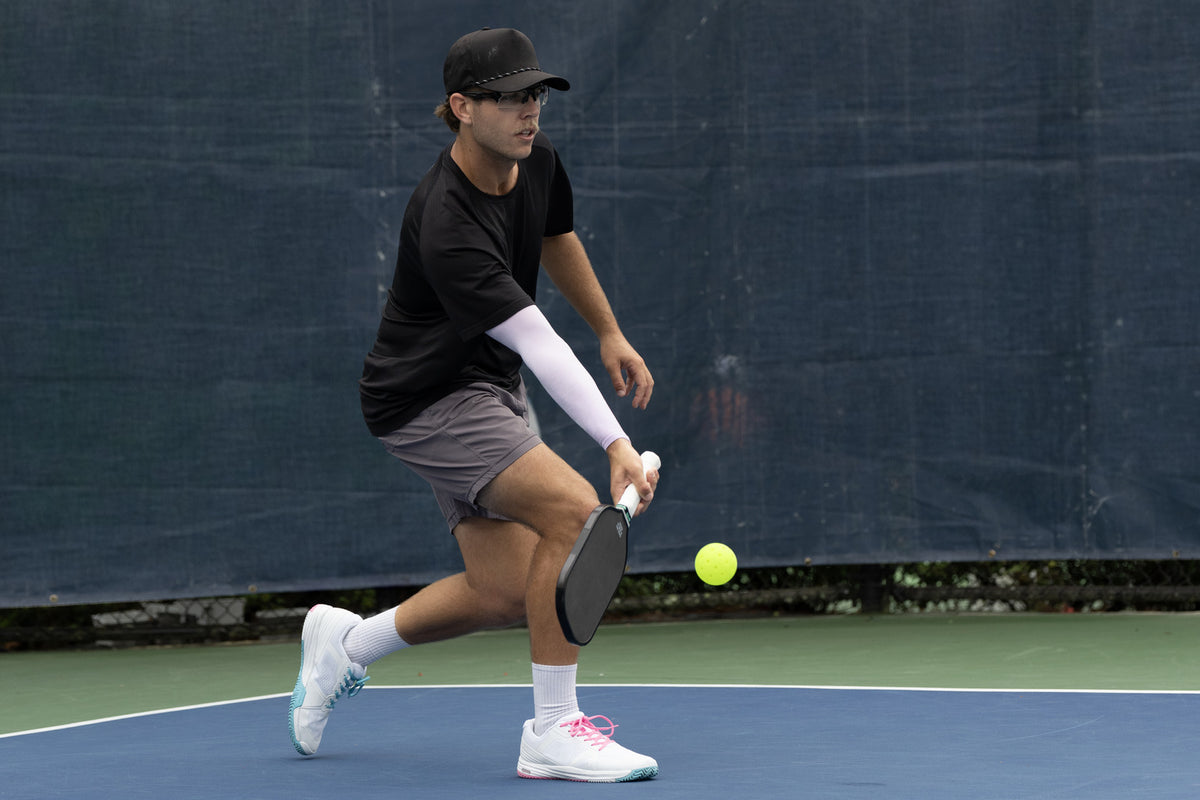
Quick answer: Grit coatings came first, raw carbon faces flooded in from 2022, and bonded and durable grits followed, turning the paddle face into a spin feature. The rules first limited the texture, which the industry learned to work around, so both rulebooks now limit the spin itself: UPA-A at 2,100 RPM for a paddle's whole useful life, and USA Pickleball at 2,100 RPM for paddles submitted from October 1, 2026. Under that cap, grit past the point where the ball grips adds feel rather than spin, and the spin you actually play with comes mostly from your swing.
A few years ago, most paddle faces were smooth to the touch, and spin came from your swing. Today the face is the feature. Brands sell raw carbon, sprayed grit and textures that renew themselves as they wear, and a common first test in a shop is to drag a thumb across the face.
That change took about four years and moved faster than the rules could follow. How it happened also explains why the grittiest face in the shop is rarely the reason anyone wins a point.
How paddles went from smooth to gritty
USA Pickleball's own testing history traces the arc. Coatings came first, and it added a friction test in 2018 "in response to new coatings placed on paddles." In 2022 came what it calls "the flood of gritty molded resin paddles known as 'raw carbon'," a carbon fiber face left unpainted with a rough resin texture on top. Since then the face has become a product category of its own, with sprayed grit coatings, hard abrasive particles such as silicon carbide (the grit on wet-and-dry sandpaper) bonded into the surface, and durable or self-renewing grits that keep exposing fresh texture as the top layer wears.
The rules measured the face, so the industry built to the face
USA Pickleball's surface rule was a set of texture limits. A profilometer reads each face in six directions, and the averages must stay at or below 30 micrometers on Rz, the average peak-to-valley height, and 40 micrometers on Rt, the maximum peak-to-valley height. A separate test caps sliding friction at 0.1875. None of those numbers is spin, and the texture readings do not even agree with each other: a face with tall, sharp peaks reads high on Rz and Rt and can still read low on Ra, the average roughness some reviewers publish. They stood in for spin because texture was easy to measure and spin was not. One durable-grit maker now says its face reads rougher than USA Pickleball's limit while its measured spin stays under 2,100 RPM, which is the trouble with the stand-in in a single sentence.
When a rule measures a stand-in, the engineering goes to the stand-in, and this year's record shows how loose that stand-in had become. USA Pickleball delisted a paddle after its maker acknowledged that the paddles it sold differed from the version it had submitted. John Kew, an independent reviewer, ran one approved paddle from each of 42 brands through USA Pickleball's roughness method, and by his readings 40 were over the limit (his tests were not run under lab conditions). And USA Pickleball's technical chief confirmed on the record that one textured surface could not be read by the roughness test at all, so the test was waived for it while the public list showed an ordinary approval. UPA-A wrote the same lesson into its rules: production paddles must measure within 10 percent of the certified samples on spin, roughness and power, no grit, adhesive, paint or resin may be added to a certified face, and a paddle found with a different finish from the one it certified with can be confiscated.
Buyers paid for the wrong signal
Brands did not run this race alone, because buyers rewarded it. In a shop, the only spin test a player can run is a thumb across the face, and rough reads as spinny. Online, buyers compare spin charts where the top paddles differ by a few percent on rigs that do not agree with each other: one large independent database averages about 2,000 RPM and another about 2,220. Neither scale matches the certification labs, which is why a reviewer's reading above 2,100 is not a rules violation. A brand that wants to sell paddles builds the face that wins the thumb test and the top line of the chart.
That pressure pointed toward more texture on day one, because day one is when the money changes hands. When rough textures wore down with play, the next pitch was durability, a fix for a problem the first pitch had created. Kew's verdict on the paddles that failed his roughness test was blunt: "None of these paddles that failed are so spinny that they're giving any player a distinct advantage on the court."
Both rulebooks now measure the ball
UPA-A, which certifies paddles for the PPA Tour and Major League Pickleball, does not certify against a texture limit. It measures the spin a paddle puts on the ball, caps it at 2,100 RPM and holds the paddle to that number "through its entire useful life." At events it reads roughness only against the paddle's own certified reading, and a face more than 25 percent rougher than that can be confiscated.
USA Pickleball followed on October 1, 2026. Paddles submitted from that date must spin the ball at 2,100 RPM or less on a dual-camera test, and the old roughness and friction limits become measurements of record rather than pass-or-fail lines. Paddles approved earlier keep their approval under the standard they passed. The two rulebooks still differ on power and on how long an approval lasts, but on spin they now agree on the limit and on measuring the ball rather than the face.

What durable grit tells you, and what it does not
Durable grit answers a real problem. Every textured face wears with play, and some spin goes with the texture, so a face that keeps its texture keeps its spin longer. Under a hard cap, holding the number is one of the few ways a surface can still be better.
It is also easy to oversell. Durable describes how long a texture lasts. The label says nothing about the spin a face starts with or settles at, and a durable face that starts lower can spend its whole life below one that starts at the cap. Grit also cannot buy spin above the line, since every paddle UPA-A certifies, and every paddle submitted to USA Pickleball from October 2026, must stay at or under 2,100 RPM on its test. And a face built to renew its texture can end up rougher than the paddle that was certified, which is why UPA-A now offers an optional roughness test after break-in for 2027 certifications.
Where spin actually comes from
Spin is made in the brief moment the ball spends on the face. As the paddle moves across the ball, friction drags the ball's surface along and sets it rotating. On a slick face the ball slides and leaves with less rotation than the swing could have given it. Once the face grips well enough that the ball stops sliding, the spin is set by how fast the face moves across the ball and at what angle, and extra grit adds little.
That makes absolute spin, the rotation actually on the ball as it crosses the net, mostly a product of the swing: paddle speed through contact, a path that brushes up or across the ball, and clean contact near the middle of the face. A fast, brushing swing on an ordinary legal face puts more spin on the ball than a push with the grittiest paddle in the shop. For the technique, see our guide to generating more spin.
Is pickleball a different game now?
It is different in how points are built, and less different than the marketing suggests in who wins them. Rolled dinks, topspin drives and the two-handed backhand roll used to be specialist shots and are now ordinary at the club level, and gripping faces helped make them repeatable for amateurs. The rules pushed spin onto the paddle too: since 2023, rule 4.A.5 has barred servers from spinning the ball with their hand on the release, so serve spin has to come off the face.
What has not changed is how close the paddles are. In one large independent database the average paddle tests near 2,000 RPM and the highest just under 2,200, so the best spin paddle on the market makes under 10 percent more than the average one on the same rig. The players who win spin exchanges do it with preparation, swing speed and shot choice, as they did when faces were smooth.
Where we land
We build the EZ Speed E16 to the spin limit. Its raw carbon face is rough by the measures the old rules used, reading well above USA Pickleball's former Rz and Rt limits on the certification lab's meter, and it is certified by UPA-A, which judges spin by what the ball does and holds the paddle to 2,100 RPM for its useful life. On that test, the E16 measured near the top of the allowance. That puts it with the best spin paddles on the market rather than above them, because the cap holds everyone to the same line. If your events run under USA Pickleball, the EZ Speed E14 is approved by both USA Pickleball and UPA-A, so it is legal in sanctioned play under either rulebook.
Whichever paddle you pick, judge it by the spin it puts on the ball, measured the same way across every paddle you compare, and judge your game by your swing. Grit is the part you can feel in the shop, and once the ball grips, it is the part that matters least.
The rulebooks stopped measuring the sandpaper and started measuring the ball, and buyers can do the same.
Frequently asked questions
What is raw carbon on a pickleball paddle?
Raw carbon is a carbon fiber paddle face left unpainted, with a rough molded resin texture on the surface. USA Pickleball dates the wave of these paddles to 2022. The texture gives the ball more grip than a smooth painted face, which is why raw carbon became the standard face for spin-focused paddles.
What is the spin limit for pickleball paddles?
Both rulebooks use 2,100 RPM. UPA-A, which certifies paddles for the PPA Tour and Major League Pickleball, caps spin at 2,100 RPM for a paddle's entire useful life. USA Pickleball requires 2,100 RPM or less, measured with a dual-camera test, for paddles submitted for approval from October 1, 2026.
Does more grit mean more spin?
Only up to a point. Grit helps the ball grip the face instead of sliding across it. Once the ball grips, the spin is set by how fast and at what angle the paddle moves across the ball, so extra texture adds little, and paddles certified under the spin tests must stay at or under 2,100 RPM however rough they are.
Is durable grit worth paying for?
It can be if you play often, because a face that keeps its texture keeps its spin longer. The label tells you how long the texture is meant to last and says nothing about how much spin the face makes, so compare measured spin on one consistent test and check that the paddle is certified for the events you play.
Are paddles approved before October 2026 still legal in USA Pickleball play?
Yes. USA Pickleball holds each paddle to the equipment standard in force when it was certified, so paddles approved under the old roughness and friction limits keep their approval. The spin rate test applies to paddles submitted from October 1, 2026.
Can a paddle become illegal as its grit changes?
Yes. Both rulebooks require a paddle to stay compliant for its whole useful life, and USA Pickleball runs ongoing compliance testing on paddles as sold. UPA-A also checks roughness at events, and a paddle more than 25 percent rougher than its certified reading can be confiscated.
Share:
Pickleball Serve Rules and How to Hit a Deep Serve