


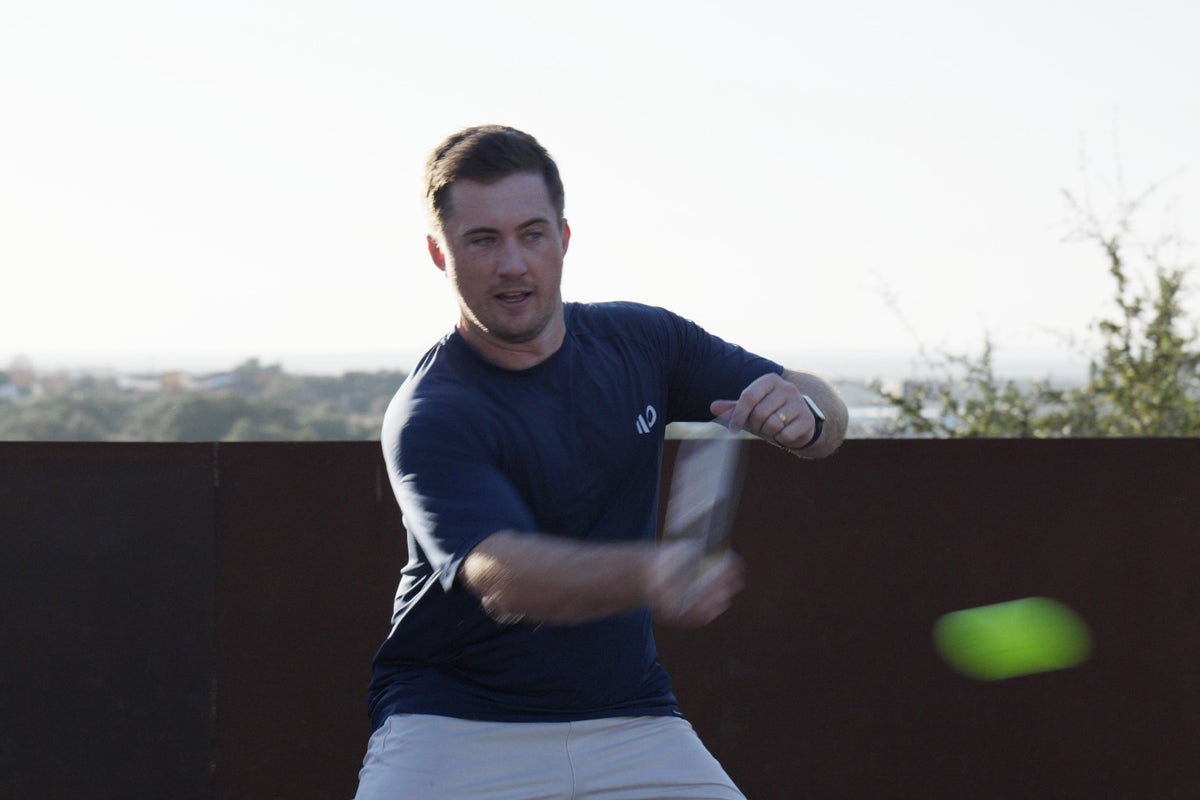
Quick answer: A legal pickleball serve is hit from behind the baseline on the correct side for the score and travels diagonally into the opponent's service court, clearing the non-volley zone and its line. You can hit a volley serve with an upward swing and contact below the waist, or a drop serve after letting the ball bounce, and you may not spin the ball as you release it. The serve that wins the most points is the deep, repeatable one, because it keeps the returner behind the baseline and slows their move to the kitchen line.
The serve is the one shot in pickleball you hit without any pressure from an opponent, and it still starts the rally at a disadvantage. The two-bounce rule makes the serving team wait for the return to bounce, while the receiving team gets a free run to the kitchen line. A serve cannot change that, but it can make the run longer.
That gives the serve two jobs, in this order. It has to go in every time, because a missed serve gives up your turn without a rally being played. Then it should land deep enough to keep the returner behind the baseline. Spin and pace come a distant third.
The rules every serve has to meet
Section 7 of the 2026 USA Pickleball Official Rulebook covers the serve. In plain terms, every serve has to meet these conditions.
- Where you stand. At least one foot must touch the ground in the correct serving area when you hit the ball, and neither foot may touch the court, including the baseline, or the ground outside the imaginary extensions of the sideline and centerline (rules 7.A.1 to 7.A.3).
- Which side. In doubles, service starts from the right after each side out and alternates sides after every point the server wins (rules 5.B.2 and 5.B.5). In singles you serve from the right when your score is zero or even and from the left when it is odd (rule 5.A.1).
- Where it lands. The ball must travel diagonally into the opponent's service court and clear the non-volley zone. The zone's lines belong to the zone, so a serve on the kitchen line is a fault, while a serve on the sideline, centerline or baseline is in (rules 7.E, 3.A.4.c and 3.A.4.f).
- The net and the players. A serve that touches the net and still lands in the correct service court is in play, so there are no lets on the serve (rule 7.E). A serve that hits a net post or any other part of the net support system is a fault (rule 13.B.1). A serve that hits you or your partner is a fault against your team, and one that hits the receiver or the receiver's partner before it lands is a fault against the receiving team (rules 7.E.4 and 7.E.5).
- The release. Release the ball with one hand or with the paddle alone, where the receiver can see it, and do not add spin as you let it go. The ball may roll off the paddle face under gravity, and the paddle can put spin on the ball at contact (rules 7.B.1 to 7.B.3). Without a referee, a receiver who sees spin added on the release may call for a replay before returning the ball (rule 7.B.2.a). With a referee, spin on the release is a fault (rule 20.E.1.e).
- The clock. The full score must be called before you serve, and you then have 10 seconds to hit the ball (rules 6.C and 6.D).
One more rule shapes recreational games. Without a referee, opponents may call only service foot faults and non-volley zone faults on you (rule 9.B.3). Any other serve fault, such as contact above the waist, is yours to call on yourself, and an opponent can only mention it after the rally (rule 9.B.4).
Volley serve or drop serve
The rules allow two kinds of serve. The volley serve is hit out of the air, and three conditions apply at contact: the paddle must be moving in a clear upward arc, the highest point of the paddle head must not be above your wrist, and the ball must be no higher than your waist (rule 7.C). Forehand and backhand motions are both legal.
The drop serve is hit after the ball bounces. You drop the ball from a natural height without throwing or pushing it, and once it is released there is no limit on how many times or where it bounces before you hit it (rule 7.D). The arc, wrist and waist conditions apply only to the volley serve, so the drop serve lets you swing more freely.
Neither one is better for everyone. The drop serve removes the timing of a toss and has fewer conditions to meet, which helps players whose volley serve drifts above the waist under pressure. The volley serve gives some players a more natural rhythm. Choose the one you can land deep twenty times in a row.
Why depth beats pace on the serve
At most levels, pace alone rarely wins a point on the serve, because the returner has the whole bounce to read the ball. Depth helps on every serve you hit. A ball that lands close to the baseline keeps the returner behind it, so their return has further to travel, their run to the kitchen line starts from deeper, and your team has more time to judge the third shot. A short serve does the opposite. It lets the returner step in, hit from inside the court and reach the kitchen line early.
Aim for the back third of the service court, roughly the last five feet before the baseline, and give the ball enough height over the net to get there. A serve that skims the tape has almost no margin, and the extra clearance is what carries the ball deep. The middle of the back third is a safe default against most returners, and a serve to a weaker backhand is a good second option as long as chasing it does not pull your target toward the sideline.

Where spin fits
Spin is legal when the paddle puts it on the ball at contact, and a topspin or slice serve can push a returner back or pull them wide. Spin added during the release is not, and under rule 7.B.2 a receiver who sees it may call for a replay before returning the ball. Heavy spin can also cost margin, because a serve that curves or dips has to be aimed further inside the lines. Treat spin as a variation to add once your deep serve is automatic.
Three serve faults and how to fix them
A foot on the baseline at contact is the easiest fault to commit without noticing. Players drift forward as they swing, and a toe that touches the line costs the serve. Starting a full step behind the baseline removes the problem.
An illegal volley serve is the next, where contact creeps above the waist or the paddle head rises above the wrist. It usually comes from reaching for extra pace. Lowering the contact point fixes it, and if it keeps happening under pressure, switching to the drop serve takes the issue away.
A serve into the kitchen is nearly always a target problem rather than a swing problem. A serve aimed at the back third with good net clearance has a long way to fall short before it reaches the non-volley zone line.
How to serve like someone who knows
- Start a step behind the baseline. It keeps your front foot off the line when your weight moves forward through the swing.
- Use the same routine every time. Check the score, pick your target, bounce the ball if that settles you, and serve well inside the 10 seconds.
- Aim for the back third. Set two cones about five feet inside the far baseline and count how many of twenty serves land beyond them.
- Clear the net with room to spare. Extra height is what carries the serve deep.
- Stay back after you serve. The return has to bounce before your team can play it, so hold your position, split step as the returner makes contact and get ready for the third shot.
- Add one variation at a time. Once the deep serve is automatic, add a serve to the backhand or a spin serve, and keep only the variation that does not cost you misses.
Where we land
The serve does not need a special paddle. It needs one that is legal where you play and that behaves the same way on the hundredth serve as on the first. Everything in this guide follows the USA Pickleball rulebook, and for events that require its approval, the EZ Speed E14 is approved by both USA Pickleball and UPA-A, so one paddle covers every event you enter. If you play UPA-A events such as the PPA Tour, the EZ Speed E16 is built to that standard's limits for power and spin. Both share an elongated 16.5 by 7.5 inch shape.
Twenty deep serves in a row will win you more points than one ace.
Frequently asked questions
What are the basic serve rules in pickleball?
Serve from behind the baseline in the correct serving area, diagonally into the opponent's service court, clearing the non-volley zone and its line. At least one foot must be on the ground behind the baseline at contact, the release must be visible and free of added spin, and you have 10 seconds to serve after the score is called.
Is the drop serve legal in pickleball?
Yes. Rule 7.D allows a drop serve. Drop the ball from a natural height without throwing or pushing it, let it bounce as many times as you like, anywhere, and then hit it. The upward arc, wrist and waist rules for the volley serve do not apply to it.
Can you hit a spin serve in pickleball?
You can put spin on the ball with the paddle at contact. You cannot spin or manipulate the ball as you release it. Without a referee, a receiver who sees spin added on the release may call for a replay before returning the serve, and with a referee it is a fault.
Is a serve that hits the net a fault?
No, as long as it carries over and lands in the correct service court beyond the non-volley zone. There are no lets on the serve, so a serve that clips the net and lands in is played.
Can a pickleball serve land on the line?
It can land on the sideline, centerline or baseline of the correct service court. A serve that lands on the non-volley zone line is a fault, because that line is part of the zone.
Where should you aim your serve?
Deep, in the back third of the service court, usually toward the middle or the returner's backhand. Depth keeps the returner behind the baseline and slows their move to the kitchen line, which matters more than pace.
Share:
Best Pickleball Paddle for Advanced Players: What Changes at 4.5