


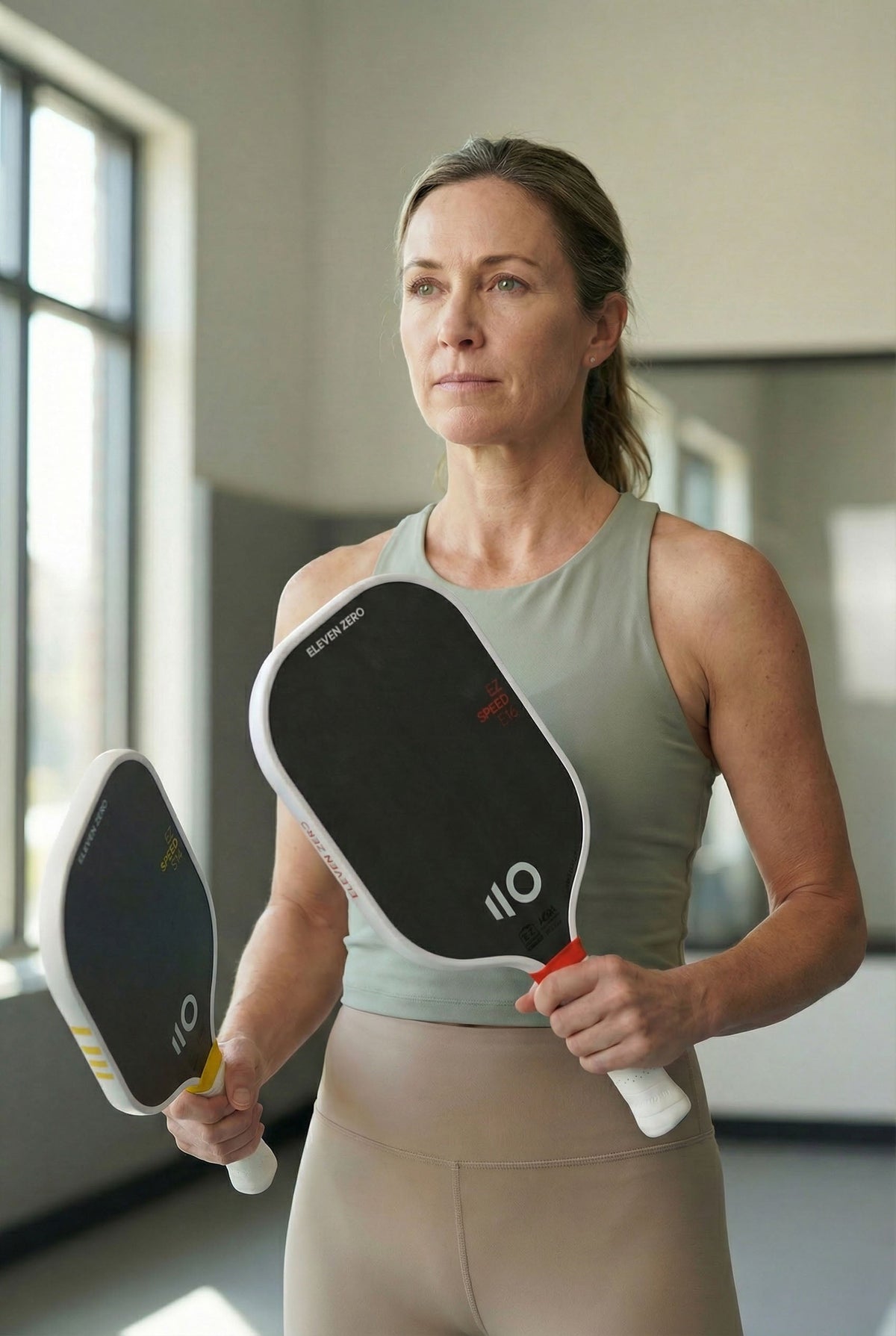
Quick answer: Own a second paddle if you compete, and make it the same model as your first. A backup that plays differently is worse than no backup, because you will pick it up on the one day your timing has no room to adapt. Recreational players are usually better served by spending the same money on a paddle cover and fresh overgrips.
The second paddle question gets answered badly in both directions. One camp says a backup is essential and stops there. The other says it is a waste and stops there. Both skip the part that decides it, which is whether the second paddle is the same paddle.
A backup exists for one moment: the frame cracks, the face delaminates, or you step on it in a warm up, and you have a match in four minutes. In that moment the only thing that helps is a paddle your hands already know.
Why a mismatched backup is worse than none
Swap paddles mid tournament and your timing has to recalibrate against a different swing weight, with no session to do it in. The mismatch shows up first on the shots with the smallest margins, which are exactly the shots that decide tight games: the reset off a body drive, the third shot drop, the counter at the kitchen.
Nothing about either paddle is at fault here. The player is the variable that has to move, and a bracket is the worst possible place to ask them to move. This is the same reason we tell people not to judge a new paddle in its first ten minutes.
Same model is not the same as identical
Two paddles of the same model, off the same line, are not clones. Static weight, swing weight and balance vary from unit to unit within any manufacturer's tolerance, and anybody who tells you otherwise is selling something. We wrote about this at length in two paddles, identical specs, and the practical version is short: your backup will be close, not exact, and you should measure rather than assume.
The good news is that this gap is fixable, and the rules give you room to fix it. USA Pickleball places no restriction on paddle weight, and section 2.E.5.a of the Equipment Standards Manual explicitly permits weighted tape as a player alteration. Section 2.E.5.b sets the boundaries: tape and decals can extend no farther than 1.0 inch above the top of the grip, and no more than 0.5 inch inside the outer edge of the paddle, or 0.5 inch inside the edge guard where one is fitted.

How to build a matched pair
- Weigh both on a kitchen scale. Grams, not ounces, because the differences you care about are in single grams and an ounce scale rounds them away.
- Match the heavier paddle, never the lighter one. You can add weight to a paddle and you cannot take it out, so the heavier of the two sets your target.
- Add tape at the same positions on both. Same locations, same lengths. Matching total weight while putting it in different places gives you two paddles with the same number on the scale and different swing weights in your hand.
- Stay inside the tape limits. No farther than 1.0 inch above the top of the grip, no more than 0.5 inch inside the edge guard. The full method is in how to add weight to a paddle without ruining it.
- Wrap both with the same overgrip, at the same tension. An overgrip adds several grams and changes handle circumference, and a fresh wrap on one paddle against a compressed wrap on the other undoes your matching.
- Rotate them. Play the backup one session in four. A paddle that has sat in a bag for six months is unfamiliar even when it is identical.
The case for not buying a second paddle
If you play three times a week in rec games and have never entered a bracket, a second paddle solves a problem you do not have. The failure you are insuring against is rare, and the cost of it is a drive home rather than a forfeited match. A paddle cover, a couple of overgrips and getting your grip size right will do more for your game than a duplicate frame sitting in a bag.
There is one exception worth naming. If you play outdoors in serious heat, a second paddle gives you somewhere to rotate to while the first one sits out of the sun, and heat does real damage over a season. We covered what actually happens to a paddle in a hot car in heat kills pickleball paddles.
The certification wrinkle for competitors
If you play under more than one sanctioning body, check that both of your paddles are approved where you play before you count either as a backup. A paddle that is legal at one event and not at another is not a spare, it is a liability you carry in your bag. The EZ Speed E14 and S14 are approved by both UPA-A and USA Pickleball, while the E16 and H14 are UPA-A approved. If the difference between those two situations is not obvious, we explained it in dual certified versus single certified paddles.
Where we land
Buy a second paddle when you start entering brackets, buy the same model you already play, and spend twenty minutes matching them properly. That sequence is worth more than any upgrade you could make with the same money. The EZ Speed E14 is the model most of our competitive players pair up, and it is legal under both rulebooks if your season crosses tours.
A backup paddle is only a backup if your hands cannot tell which one they are holding.
Frequently asked questions
Do I need a backup pickleball paddle?
You need one if you compete in tournaments, where a cracked frame between matches ends your day. For recreational play a backup solves a rare problem at full price, and the same money spent on a paddle cover, fresh overgrips and the correct grip size will do more for your results.
Should my backup paddle be the same model?
Yes. A different model forces your timing to recalibrate against a different swing weight at the exact moment you have no session available to do it in. The shots that suffer first are resets, third shot drops and counters, which are the shots that decide close games.
Are two paddles of the same model identical?
No. Static weight, swing weight and balance vary from unit to unit within any manufacturer's tolerance, so two paddles of the same model will be close rather than exact. Weigh both and match them with weighted tape rather than assuming the spec sheet describes the individual paddle in your hand.
Is it legal to add lead tape to match two paddles?
Yes. USA Pickleball places no restriction on paddle weight, and section 2.E.5.a of the Equipment Standards Manual lists weighted tape among permitted player alterations. Section 2.E.5.b limits where it can go: no farther than 1.0 inch above the top of the grip, and no more than 0.5 inch inside the outer edge or inside the edge guard.
How often should I play with my backup paddle?
Roughly one session in four. A paddle that has sat unused for months feels unfamiliar even when it is the same model and the same weight, and rotating them also spreads face wear so the two paddles age at a similar rate.
Share:
Edge Guard vs Edgeless Paddles: What the Guard Really Does