


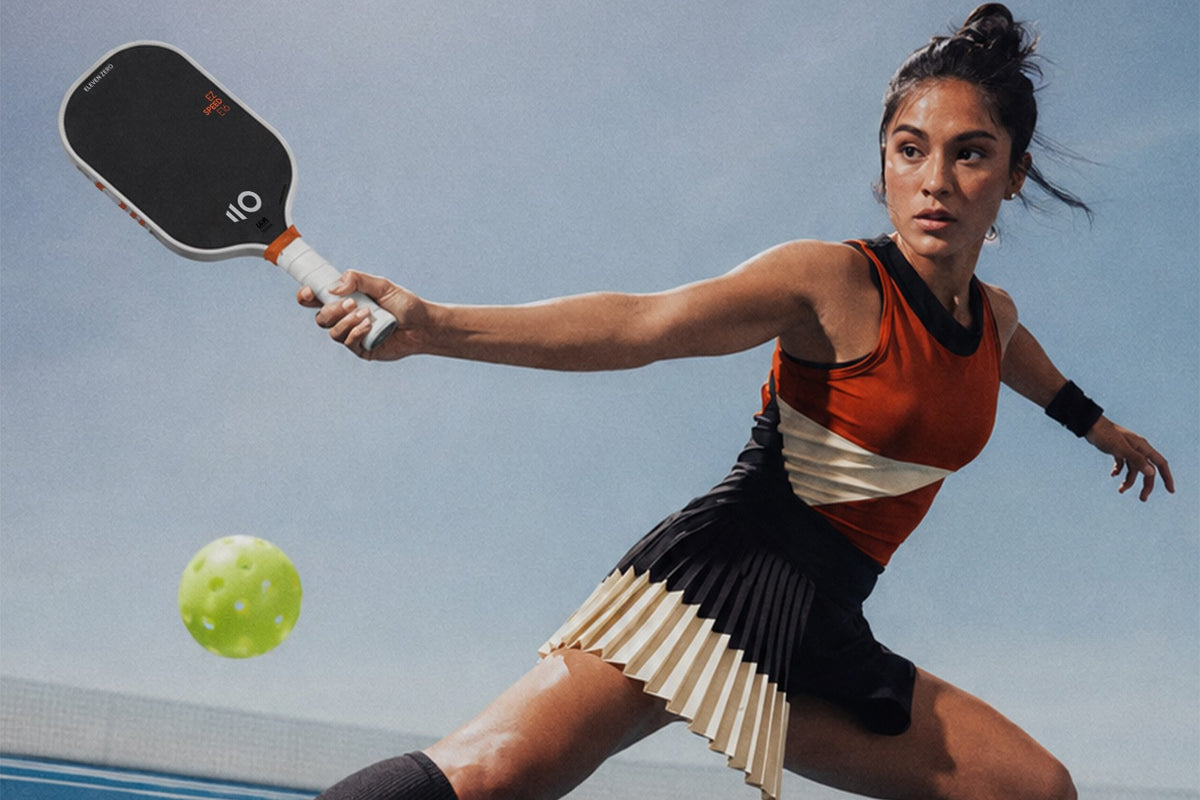
Quick answer: Racquetball is played inside a four-wall court 20 feet wide and 40 feet long, with the walls and ceiling in play, a strung racquet and a ball that must reach the front wall before it touches the floor. Pickleball is played on an open 20 by 44 foot court divided by a net, with a solid paddle, a molded ball with holes, a two-bounce rule and a 7 foot non-volley zone.
Racquetball vs pickleball looks like a contest between very different sports until you measure the courts, because both are 20 feet wide. Under standard rules both also score only on serve, and both use the same serving order in doubles. The differences that decide points sit in the walls, the net and the rules on hitting the ball out of the air. This guide compares them rule by rule from each official rulebook.
The court: one shared space or two halves
A racquetball court is 20 feet wide, 40 feet long and 20 feet high, and nearly every surface is in play. A pickleball court is 20 feet wide and 44 feet long, with no walls in play. The floor areas are close, 800 square feet against 880, but they are used in opposite ways.
Racquetball players share the whole court and the same front wall, which is why its rulebook spends so much space on hinders. A pickleball net, 34 inches high at the center, splits the court into two halves of 20 by 22 feet, and each side defends its own.
Walls against a net
A racquetball return must reach the front wall before the floor, directly or off another wall or the ceiling, and a ball that passes you can come back off the back wall. Pickleball replaces the front wall with a target on the floor. A return has to land on the opponent's side of the net, and a ball that gets past you will not come back, so deep balls have to be taken before their second bounce.
The same rule brings something new: a ball that first lands outside the opponent's court is a fault against the player who hit it, so a shot heading long or wide can be left alone.
The kitchen and the two-bounce rule
In racquetball the receiver may hit the serve on the fly once it has crossed the receiving line. Pickleball limits the volley twice. The two-bounce rule makes the receiver let the serve bounce and the serving side let the return bounce, and every volley must start outside the non-volley zone, which players call the kitchen and which extends 7 feet from the net.
Together the two rules pull both teams up to the kitchen line, where they trade soft shots called dinks until one side gets a ball high enough to attack. Those exchanges reward patience and touch more than pace.
The serve
A racquetball server gets two chances. From the 5 by 20 foot service zone, the server bounces the ball and strikes it to the front wall, and the rebound must land beyond the short line. Short serves, long serves that reach the back wall first and serves off both side walls or the ceiling are faults, and a server hitting a hard, low drive serve toward the near side wall must start and stay outside the 3 foot drive serve zone.
A pickleball server gets one serve, and a fault loses the rally. The serve goes diagonally and must clear the kitchen, so the kitchen line plays the part of racquetball's short line. The drop serve is the closest match to a racquetball serve: release the ball from a natural height without propelling it, let it bounce, then hit it. A volley serve is hit with the paddle moving upward, its head below the wrist and contact no higher than the waist.
Scoring
Both sports use side-out scoring in their standard form, so only the serving side can win a point. Racquetball matches are best of three, with games to 15, a tiebreaker to 11 and no two-point margin. A pickleball game usually goes to 11 and must be won by 2, and some events use rally scoring, a provisional option in which every rally scores.
In doubles, both sports have each partner serve before a side out, except at the start of a game, when the team serving first gets only one server. Our guide to pickleball scoring explains the three-number call that goes with it.
Racquets, paddles and balls
A racquetball racquet is strung, its frame may be up to 22 inches long, and a cord ties it to the player's wrist. The ball is close to 2 1/4 inches across and must bounce 68 to 72 inches in the rulebook's 100 inch drop test.
A pickleball paddle has no strings. It must be rigid and non-compressible, with no holes, rough texturing or rubber on the hitting surface, and it may be no more than 17 inches long. The ball is molded with a smooth surface and holes. Without strings, the core and face decide how the ball comes off the paddle.
What carries over from racquetball
Hand speed is a racquetball player's biggest asset, because fast exchanges at the kitchen line go to the player who gets the paddle face to the ball first. A quick wrist helps on counterattacks when a ball comes up high, and reading angles off an opponent's contact transfers directly. Side-out scoring and the doubles serving order need no new learning.
What a racquetball player has to unlearn
The first habit to drop is waiting for the wall. Move to deep balls early, and let the ones heading out go by untouched.
The second is hitting low and hard by default. A racquetball shot only has to beat the floor to the front wall, while every pickleball shot has to clear a net, and at the kitchen line the winning shot is more often a soft one that lands short and stays low.
The third is taking every ball early. Let the serve and the return bounce, stay behind the kitchen line when you volley, and keep dinking until a ball comes up that you can attack. Our pickleball vs tennis guide covers the same adjustments for tennis players.
Where we land
Every EZ Speed paddle uses our TriZone Core: an EPP foam center for pop, a soft EVA band for feel, and firm edge foam that keeps off-center hits steady. On that core the 14mm hits softer and resets more easily, and the 16mm is plush, stable and more powerful.
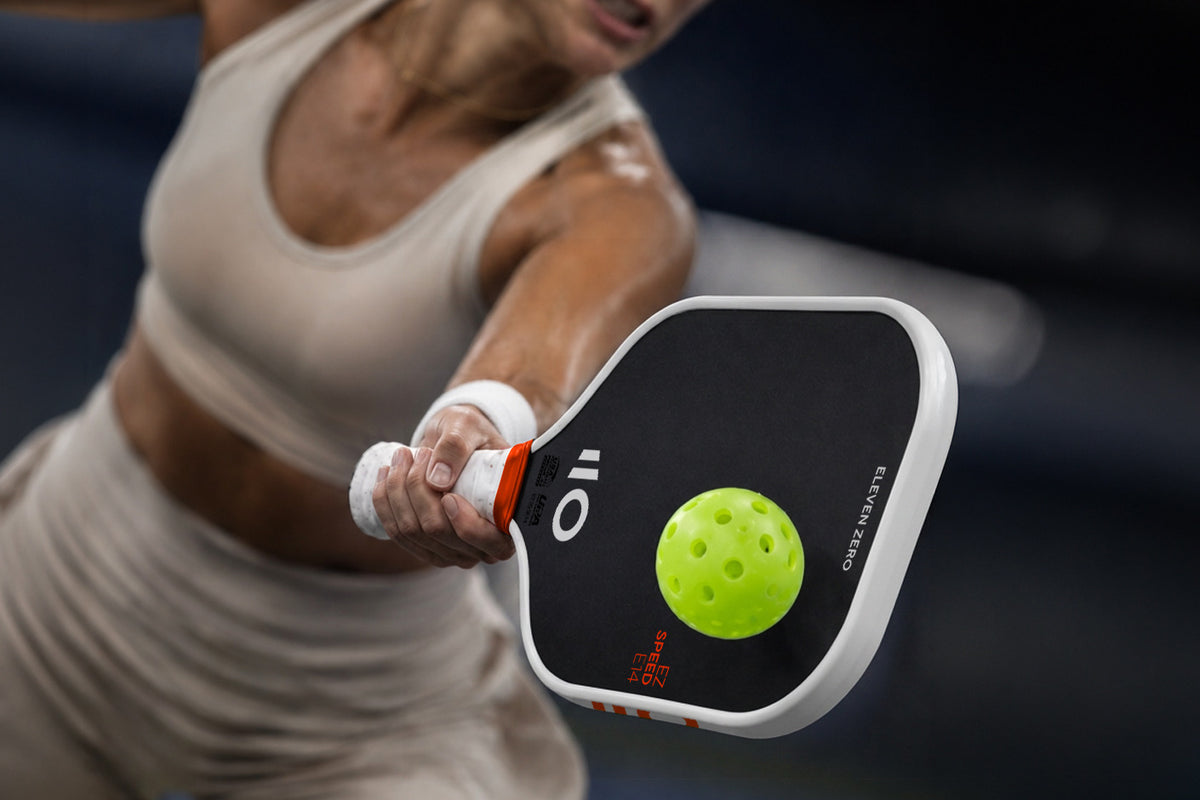
For a racquetball player's first paddle we suggest the EZ Speed E14, our elongated 14mm paddle, because its softer contact keeps resets short, and the soft game is the skill a hard hitter most needs to add. It has the 4 1/4 inch grip of every EZ Speed paddle and is approved by both USA Pickleball and UPA-A.
For the most control at the kitchen, the EZ Speed S14, our widebody paddle, has the widest face and the lowest swing weight in the EZ Speed line, and it is also approved by both bodies. Our guide to pickleball paddles for control explains how width and weight steady a face on resets.
Players who want to keep winning with drives can choose the EZ Speed E16, our elongated 16mm paddle, for more pace. It is approved by UPA-A, so a player at USA Pickleball sanctioned events should choose the EZ Speed E14 or the EZ Speed S14 instead.
Paddles ordered on our site come with a 30-day risk-free trial, with an exchange or a full refund if one does not suit your game.
Bring your hands from racquetball, and let the kitchen line teach you to wait.
Frequently asked questions
What is the difference between pickleball and racquetball?
Racquetball is played in an enclosed court 20 feet wide and 40 feet long, where the walls and ceiling are in play, with a strung racquet and a ball that must reach the front wall before it touches the floor. Pickleball is played on an open 20 by 44 foot court with a net, a solid paddle and a molded ball with holes, and it adds a two-bounce rule and a 7 foot non-volley zone.
Is a racquetball court the same size as a pickleball court?
They are the same width. A racquetball court is 20 feet wide, 40 feet long and 20 feet high, while a pickleball court is 20 feet wide and 44 feet long. Racquetball players share the whole court, while a pickleball net splits it into two halves of 20 by 22 feet.
Can you use a racquetball racquet to play pickleball?
Not under the pickleball rules. A pickleball paddle must be made of rigid, non-compressible material, and its hitting surface may not have holes that break the surface, so a strung racquet does not qualify. A racquetball racquet frame can also be up to 22 inches long, while a pickleball paddle may be no longer than 17 inches.
Is racquetball scoring the same as pickleball scoring?
Partly. Under standard rules in both sports only the serving side can score. Racquetball games go to 15, with a tiebreaker to 11, and the first side to reach the score wins. A pickleball game usually goes to 11 and must be won by 2, and some events use rally scoring, in which every rally wins a point.
Do racquetball skills transfer to pickleball?
Many do. Hand speed, a quick wrist, reading an opponent's contact and familiarity with side-out scoring all carry over, and the drop serve keeps the bounce and strike of a racquetball serve. The main adjustments are letting the serve and the return bounce, staying out of the kitchen when you volley and trading low, hard shots for soft ones at the net.
Share:
Best All-Court Pickleball Paddle: How to Find the Balance