


Quick answer: In the United States, "paddle tennis" names two sports. POP Tennis, the renamed paddle tennis, uses a perforated paddle and a low-compression tennis ball on a court 50 or 60 feet long. Platform tennis is a winter doubles game played on a raised, heated deck, where the ball stays in play off the wire screens. Pickleball shares platform tennis's 20 by 44 foot court but uses a solid paddle, a plastic ball with holes, an underhand serve and a 7 foot non-volley zone at the net.
Pickleball vs paddle tennis is a harder comparison than it looks, because the second name covers more than one sport. This guide separates the sports, then compares pickleball with each one from its governing body's own rules.
Which sport is paddle tennis?
The first sport with the name is paddle tennis itself, a smaller version of tennis. Its American governing body, the United States Paddle Tennis Association, rebranded the game as POP Tennis and in 2016 renamed itself the International POP Tennis Association, so the two names describe one sport.
Platform tennis is a separate game, and its governing body, the American Platform Tennis Association, notes that it is often referred to as paddle tennis. It began in 1928 in Scarsdale, New York, and is still played outdoors, mostly in cool or cold weather, on raised courts with heaters under the deck.
Search results for paddle tennis also return padel, a walled doubles game played on a 20 by 10 meter court, which our padel vs pickleball guide covers in full.
The court and the net
Platform tennis and pickleball share a footprint. Both courts measure 20 by 44 feet, and both nets stand 34 inches high at the center, rising to 37 inches at the platform tennis posts and 36 inches at a pickleball sideline. The platform court sits on a 60 by 30 foot deck inside a screen 12 feet high, the same area the pickleball rulebook sets as the minimum playing surface for one court.
The classic POP Tennis court is 50 by 20 feet, 6 feet longer than a pickleball court, with a net 31 inches high straight across. POP Tennis is also played on a 60 foot court, where the net stays at the tennis height of 36 inches in the middle.
Screens, fences and a ball that gets past you
The screens set platform tennis apart. A ball that bounces in the correct court stays in play off the back or side screens until it bounces a second time, and the defending team may return it as long as the return goes straight into the opponents' court.
Pickleball treats the fence as a permanent object, so a ball that bounces in and reaches the fence before the defending player returns it is a fault against that player. The POP association says its rules match tennis apart from the serve, so the fence works the same way in POP Tennis.
The serve
All three sports give a doubles server one attempt. A POP Tennis serve is underhand and struck below the waist, no higher than the net, and a serve that clips the net cord and lands in the correct box is replayed as a let.
Platform tennis leaves the motion to the server, who tosses the ball by hand and strikes it before it lands, overhand, underhand or sidearm. There is no service let, so a serve that touches the net cord and lands in the correct box is in play.
A pickleball volley serve must be hit underhand, with an upward arc, a paddle head no higher than the wrist and contact no higher than the waist. A drop serve is hit instead after the ball is released from a natural height and bounces. Either serve must clear the 7 foot non-volley zone, with or without touching the net, so a pickleball serve is aimed deep, while a platform tennis serve lands in a box that ends 12 feet from the net.
The kitchen and the two-bounce rule
Pickleball's biggest difference from both paddle tennis sports sits at the net. The non-volley zone, which players call the kitchen, extends 7 feet from the net, and no player may volley while standing in it. The two-bounce rule then makes the receiving side let the serve bounce and the serving side let the return bounce before anyone may volley.
Platform tennis bars only the receiver from volleying the serve, and POP Tennis doubles allows serve and volley outright. Neither sport marks a zone where volleys are banned, so players in both may volley from right against the net.
Scoring
Both paddle tennis sports keep tennis scoring. Points run 15, 30, 40 and game with deuce and advantage, a set goes to six games by two with a tiebreaker at six all, and a match is usually the best of three sets.
Pickleball keeps score its own way. Under standard scoring only the serving side can win a point, and a game usually goes to 11, won by 2. Some events use rally scoring, a provisional option in which every rally wins a point for one side.
Paddles and balls
All three sports use a stringless paddle. A POP Tennis paddle may be up to 18.5 inches long with a face up to 10 inches wide, and it has holes through its carbon fiber or fiberglass face. A platform tennis paddle may be up to 18 inches long, 12 inches wide and 500 grams, about 17.6 ounces, with a substantially flat face that may carry a separate texturing material.
A pickleball paddle is shorter and solid. The rules cap its length at 17 inches and its length plus width at 24 inches, and its face may not have holes that break the surface, rough texturing or sandpaper characteristics.
The balls differ too. POP Tennis uses a green dot tennis ball with 75 percent of a standard ball's internal pressure, platform tennis uses a rubber ball with flocking, and pickleball uses a smooth molded plastic ball with holes through it.
What carries over to pickleball
Players from either sport already know doubles, a stringless paddle and points played close to the net. POP Tennis players also bring an underhand serve and the quick hands that the POP association credits to its short court, and platform tennis players arrive on a court with the same outer dimensions.
The adjustments come at the net and the baseline. Stay behind the kitchen line when you volley, let the serve and the return bounce, and take deep balls before they get past you, since no screen will bring them back. Overhand servers need a new underhand motion. Our complete beginner's guide covers the rest of the rules, and pickleball vs tennis answers the same questions for tennis players.
Where we land
For a paddle tennis or platform tennis player buying a first pickleball paddle, we suggest the EZ Speed S14, our widebody paddle. Its 8.1 inch face is the widest in the EZ Speed line, and its swing weight of 106 is the lowest in the line, so it swings quickly at the net. It is our control-first paddle, and it is approved by both USA Pickleball and UPA-A.
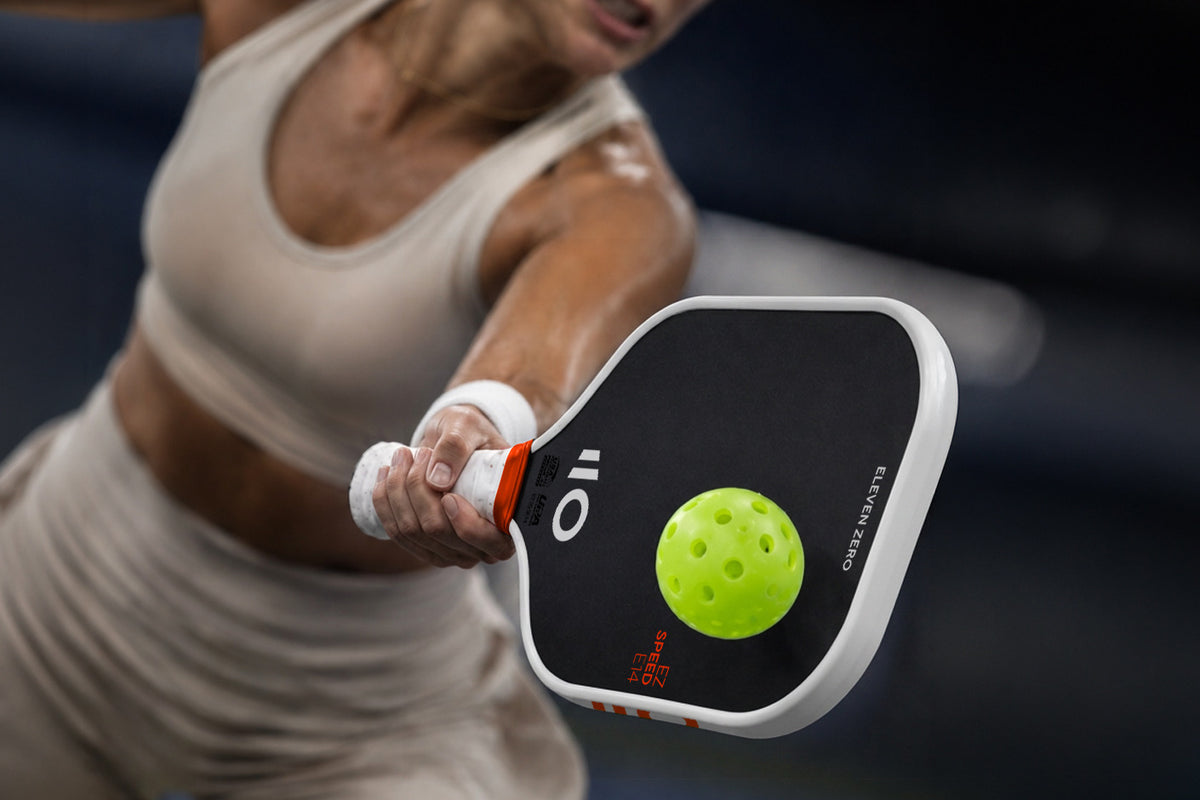
Players who want the elongated shape, now the standard in pickleball, can choose the EZ Speed E14, our elongated 14mm paddle, also approved by both bodies. Both paddles use our TriZone Core: an EPP foam center for pop, a soft EVA band for feel, and firm edge foam that keeps off-center hits steady. At 14mm that core hits softer and resets more easily than our 16mm paddles, which helps while you learn the soft game at the kitchen line.
Paddles bought on our site come with a 30-day risk-free trial. If one does not suit your game after real matches, exchange it for another model or return it for a full refund.
Whichever paddle tennis you grew up on, pickleball keeps the partner and the paddle, and asks you to win the point from behind a 7 foot line at the net.
Frequently asked questions
What is the difference between pickleball and paddle tennis?
Paddle tennis can mean POP Tennis, played on a 50 or 60 foot court with a perforated paddle, a low-compression tennis ball and tennis scoring, or platform tennis, played on a 20 by 44 foot court on a heated deck where the ball can be played off the screens. Pickleball uses a 20 by 44 foot court with no screens in play, a solid paddle and a plastic ball with holes, and it adds a 7 foot non-volley zone and a two-bounce rule.
Is paddle tennis the same as padel?
No. The name paddle tennis is used for POP Tennis and for platform tennis, while padel is a separate sport played by pairs on a 20 by 10 meter court enclosed by walls. Search results often mix the names, so check which sport a page describes.
Is a platform tennis court the same size as a pickleball court?
Yes. Both courts measure 20 by 44 feet, and both nets are 34 inches high at the center. The platform tennis court sits on a deck with a 60 by 30 foot playing area enclosed by a 12 foot screen, and its net rises to 37 inches at the posts, compared with 36 inches at a pickleball sideline.
Can you use a paddle tennis paddle to play pickleball?
Not in sanctioned pickleball. A POP Tennis paddle has holes in its face, which the pickleball rules prohibit, and it can be up to 18.5 inches long, over the 17 inch limit for a pickleball paddle. A platform tennis paddle can be up to 18 inches long, and sanctioned play under USA Pickleball rules requires a paddle on its approved list.
Do paddle tennis skills transfer to pickleball?
Many do. Doubles teamwork, quick hands at the net and the habit of playing close to the net all carry over, and POP Tennis players already serve underhand. The new parts are the two-bounce rule, staying out of the kitchen when you volley and taking deep balls before they get past you, since no screens bring them back.
Share:
Pickleball vs Racquetball: What Changes Without the Walls