


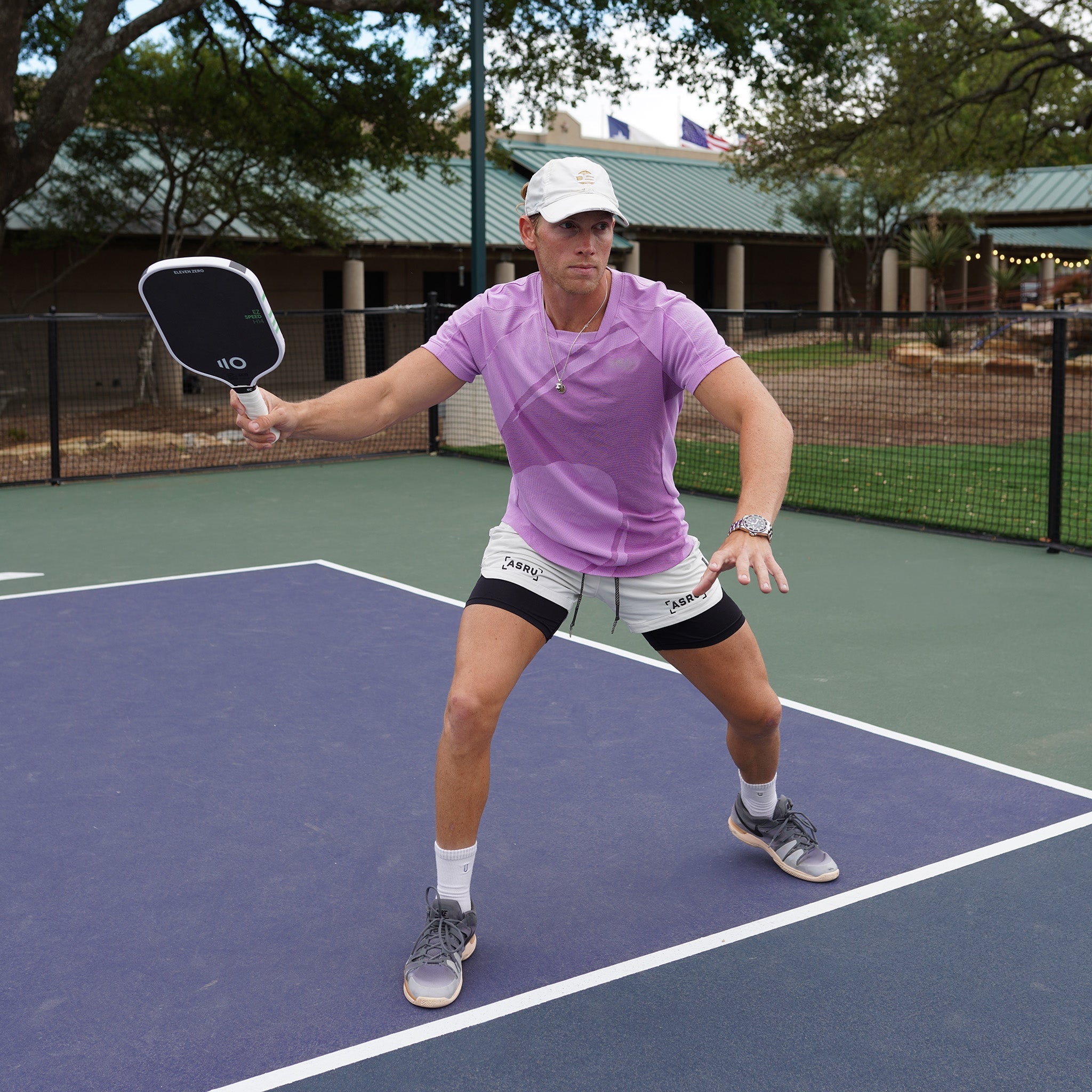
I'm going to be honest here. Most players pick a paddle face material off marketing copy instead of what the surface actually does on the ball. Put paddles with different faces side by side and the gaps are real, but they show up in specific places: spin, how the grit wears, and feel. Power barely moves.
The face you choose comes down to spin generation, surface wear, and how the paddle feels on third-shot drops and counters. Raw carbon, fiberglass, and Kevlar each behave differently, and the differences are smaller than the marketing suggests. Spin clusters tightly across the whole market, roughly within 150 RPM, and most paddles hit close to their max spin when they are new. So the real question is not which face spins hardest out of the box. It is which one holds up.
Raw carbon fiber: high spin, but the grit is the catch

Raw carbon is the default for serious players, and the spin numbers back it up. Carbon faces land near the top, around 2002 RPM in independent testing. Our EZ Speed E14 uses a thermoformed face built from carbon and fiberglass layers (a 90/0/90 layup) over a floating EPP foam core, and you feel that grab immediately on drives and serves.
The grit is what does the work. That microscopic texture grabs the ball at contact and is most of why carbon spins the way it does. Here is the part the marketing skips: raw carbon grit wears smooth. In Taber abrasion testing, raw carbon faces can sand down to slick in roughly 50 cycles. The spin is great when the paddle is new. Grit life is the durability problem, not a strength. Anyone telling you raw carbon "maintains texture longer" or "improves after break-in" has it backwards. Background on carbon fiber reinforced polymers (CFRP) covers the material's strength, but strength of the fiber is not the same thing as how long the surface grit survives.
T700 vs T300 carbon fiber: the technical breakdown

Not all carbon is the same grade. T700 runs about 4900 MPa tensile strength against roughly 3530 MPa for T300, so T700 is around 39% stronger. That is a real difference in the fiber:
- T700 carbon fiber: higher grade, better fatigue resistance, stiffer panel
- T300 carbon fiber: more common, still solid, lower tensile strength
One caution worth stating plainly: a stronger fiber does not mean the grit lasts longer. Tensile strength is about the panel and the structure. Surface grit life is a separate question, and on raw carbon it is short regardless of grade. Treat the T700 number as a structural spec, not a promise about texture.
Who carbon fiber is for: players who want spin and a stiffer, crisper feel, and who are fine refreshing or replacing a face once the grit goes slick. If your game lives on topspin drives and serves, carbon is the material. Just go in knowing the bite is sharpest early.
Fiberglass: the all-court workhorse
Do not write off fiberglass for being older. A good fiberglass face is forgiving and steady, with strong vibration dampening and a softer, more buttery response than carbon. The catch is spin. Fiberglass sits at the bottom of the face materials for RPM, around 1903 in testing, below both carbon and Kevlar.
Where fiberglass earns its keep is touch. The softer surface gives better feedback on dinks and drops, so you can shape the ball with more precision. You will not match carbon or Kevlar on raw spin, but a well-built fiberglass face still generates usable spin with good technique. A review of glass fiber composite properties notes fiberglass's vibration dampening relative to carbon composites.
One myth to retire: fiberglass does not hand you more power. Across faces and paddle generations, power differs by only about 2.5%. If a paddle feels poppier, that is usually the core and the build, not the glass.
The surface wear reality
Fiberglass texture does smooth out with play, and you will lose some initial bite over time. That is true of textured faces generally. It is not unique to glass, and raw carbon is no better here. If anything, raw carbon grit goes first.
The thing that matters most is the starting surface treatment. Cheap fiberglass with minimal texture goes slick fast. A premium face with proper surface prep holds usable grip for a long while.
Who fiberglass is for: all-court players who value touch and feel over peak spin. If you have arm issues or want a softer response, the vibration dampening is a real plus. It also suits players moving from recreational into competitive play who want forgiveness.
Aramid: durability with spin that holds up

Aramid is the most misread material in pickleball. Players file it under "low spin" without checking the numbers. They are wrong. Aramid faces test around 2012 RPM, essentially tied with carbon at the top and clearly above fiberglass. So aramid is not a spin compromise. What it adds on top is surface life: it resists going slick far better than most faces.
An aramid face is built for long-term consistency, holding its playing characteristics across heavy use. That predictability is worth a lot if you want the paddle to feel the same in month six as it did on day one. DuPont's data on Kevlar aramid fiber shows the material keeps its mechanical properties under repeated stress longer than most competing fibers.
The feel factor
Aramid has a dense, distinctive feel. It is not as springy as carbon or as plush as fiberglass. It reads as soft and connected, and when you catch the sweet spot you know right away.
It also forgives mishits better than carbon. Carbon can punish an edge hit, while an aramid face tends to hold ball speed and direction on off-center contact.
Who aramid is for: players who want spin that stays consistent and a face that does not wear out quickly. If you play 15-plus hours a week or want the same response session after session, aramid is a strong pick. It also fits placement players who care more about repeatable contact than peak power.
Spin generation: the real performance data

Here is the spin picture that holds up to testing rather than marketing:
- Kevlar / aramid: around 2012 RPM, top of the group
- Raw carbon fiber: around 2002 RPM, effectively tied with Kevlar
- Fiberglass: around 1903 RPM, the lowest of the three
Carbon and Kevlar both out-spin fiberglass, and they sit close to each other at the top. The whole spread is tight, roughly within 150 RPM market-wide, and most paddles reach near their peak spin when new. The differences you feel show up most on serves and drives where you load the ball hardest.
Why surface matters more than core for spin
Core construction shapes power, feel, and sound. Spin is almost entirely about the face: the material and its grit. Run identical cores with different faces and the spin order tracks the material, not the core. A carbon or aramid face will out-spin the same build with fiberglass. The USA Pickleball equipment standards regulate surface roughness for this exact reason, because face texture drives ball behavior.
Understanding paddle construction: core and face working together
Face material drives spin, but the core under it shapes power, feel, and sound. The two interact in ways worth knowing. A foam core like the floating EPP in the EZ Speed line spreads energy across a wider sweet spot and runs quieter, which pairs well with a stiff thermoformed face. A honeycomb core, like the 8mm-cell honeycomb in our EZ Pro Origin H13, gives a more direct, livelier pop. The face you choose sets the spin ceiling. The core decides how the paddle delivers power and how forgiving it feels off-center.
Durability and surface wear patterns
How a face ages should weigh heavily in the decision. Here is the reality based on abrasion testing rather than vibes:
Carbon fiber wear
Raw carbon, including T700 grade, starts with excellent grit and loses it. In Taber testing the grit can wear smooth in roughly 50 cycles. The fiber stays strong, but the surface bite is the first thing to go. Plan on the spin being best early and fading as the texture flattens.
Fiberglass lifecycle
Fiberglass smooths gradually with play, the same direction as carbon. It starts lower on spin and keeps drifting down as the texture wears. A quality glass face stays playable for a long while, but it does not improve with break-in.
Aramid consistency

This is where aramid pulls ahead. Aramid faces resist wear better than carbon or glass, holding their characteristics far longer. Combine that with top-of-group spin and you get a face that stays consistent instead of fading.
Power and feel differences
Worth saying up front: power barely changes across face materials, about 2.5% between them. The pop you feel is mostly the core and the build, not the face. With that in mind, the faces still feel different.
Carbon reads as crisp and efficient, with a sharp response off a stiff panel. Fiberglass delivers power more softly, which helps players who tend to overhit or who want better touch for placement. Kevlar sits in a dense, connected middle, where you control output through technique rather than leaning on the paddle. None of these will out-power the others by much. Pick on feel and spin durability, not on a power claim.
Two of our paddles show the difference on one core: the EZ Power Carbon 16mm uses a T700 carbon fiber face over a 16mm honeycomb core, and the EZ Power K-16 pairs an aramid fiber face with the same 16mm honeycomb.
Cost vs performance
On pricing, be honest. T700 carbon and aramid faces cost more to make, and that flows to the sticker. But cost per playing hour often favors a face that holds its characteristics, which is where aramid's wear resistance pays off.
For frequent players, a face that stays consistent is usually the better long-run value than one that spins great for a month and then goes slick.
Matching face material to playing style
Aggressive baseline players
If you live on topspin drives and heavy serves, carbon or aramid both deliver the spin you want, and they spin nearly the same. Carbon gives the crisper, stiffer feel and the sharpest early bite. Just know the grit fades, so refreshing or replacing the face is part of the deal. Our EZ Pro Origin H13 pairs a soft matte carbon face with a flex-profile, honeycomb power build for players who want pop without going harsh.
All-court versatility
Players who blend power and finesse should look at the EZ Speed line. The EZ Speed E14 is a thermoformed paddle with a triple-layer carbon and fiberglass face in a 90/0/90 layup over a floating EPP foam core. That mix gives you carbon-level grab with the wider, more forgiving sweet spot of a foam core, which is exactly what an all-court game wants. At $219.95 it is dual-certified for USAP and UPA-A play.
Consistency-focused players
If you want predictable performance that does not drift, an aramid face delivers spin near the top of the group and holds it longer than carbon or glass. Players who win on placement and repeatable contact get the most out of that stability.
Making your decision
Here is the honest framework:
Choose raw carbon if: you want a crisp, stiff, high-spin face and you accept that the grit is sharpest when new. The EZ Speed E14 brings a thermoformed carbon and fiberglass face with the forgiveness of a foam core.
Choose fiberglass if: you want the softest feel and the best vibration dampening, you value touch over peak spin, or you are watching budget. Just do not expect it to out-spin carbon or aramid, because it sits lowest of the three.
Choose Kevlar if: you want spin that stays near the top of the group and a face that resists wear. Aramid gives you consistency over a long season without giving up RPM, which is rare.
Any of these can work for your game. The real move is honest self-assessment of what you want from the surface, and weighing how the grit ages, not just how it spins on day one. For more on picking the right paddle for your level, see our guide to the best paddles for intermediate players.
You can compare faces side by side in our paddle collection, or browse the full catalog. Each material earns its place for specific reasons. The trick is matching those reasons to your game.
Frequently asked questions
Which pickleball paddle face material generates the most spin?
Kevlar and raw carbon are essentially tied at the top, around 2012 and 2002 RPM in testing. Fiberglass is the lowest of the three at roughly 1903 RPM. Both carbon and Kevlar out-spin fiberglass, and the overall spread between materials is tight.
How long does the grit last on different paddle face materials?
Raw carbon grit wears smooth fastest. In Taber abrasion testing it can go slick in around 50 cycles, so its spin is best when new. Fiberglass also smooths over time. Kevlar aramid resists wear the longest and holds its characteristics far better than either.
What's the difference between T700 and T300 carbon fiber?
T700 is the higher grade, around 4900 MPa tensile strength versus roughly 3530 MPa for T300, about 39% stronger. That is a structural difference in the fiber and panel. It does not mean the surface grit lasts longer, since grit life is a separate question and is short on raw carbon regardless of grade.
Should beginners avoid carbon fiber paddles?
Not necessarily. Carbon spins well and feels consistent, and a paddle with a larger sweet spot makes it manageable for newer players. A foam-core build like the EZ Speed E14 widens that sweet spot, which helps. Focus on technique rather than avoiding the material. Our beginner's guide covers what new players need to know.
Why do some players prefer fiberglass over carbon fiber?
Fiberglass has a softer, more forgiving feel with strong touch for dinking and drops, and good vibration dampening for players with arm issues. It is often more affordable too. The trade-off is spin, since fiberglass sits lowest of the three face materials.
Is Kevlar worth the premium for paddle faces?
For many players, yes. Aramid spins near the top of the group and resists wear better than carbon or glass, so the surface stays consistent over a long season. If you value spin that holds up and a stable feel, the durability earns the price.
Share:
Common Paddle Myths That Hold Players Back
Best Pickleball Paddles for Intermediate Players in 2026: What Actually Matters