


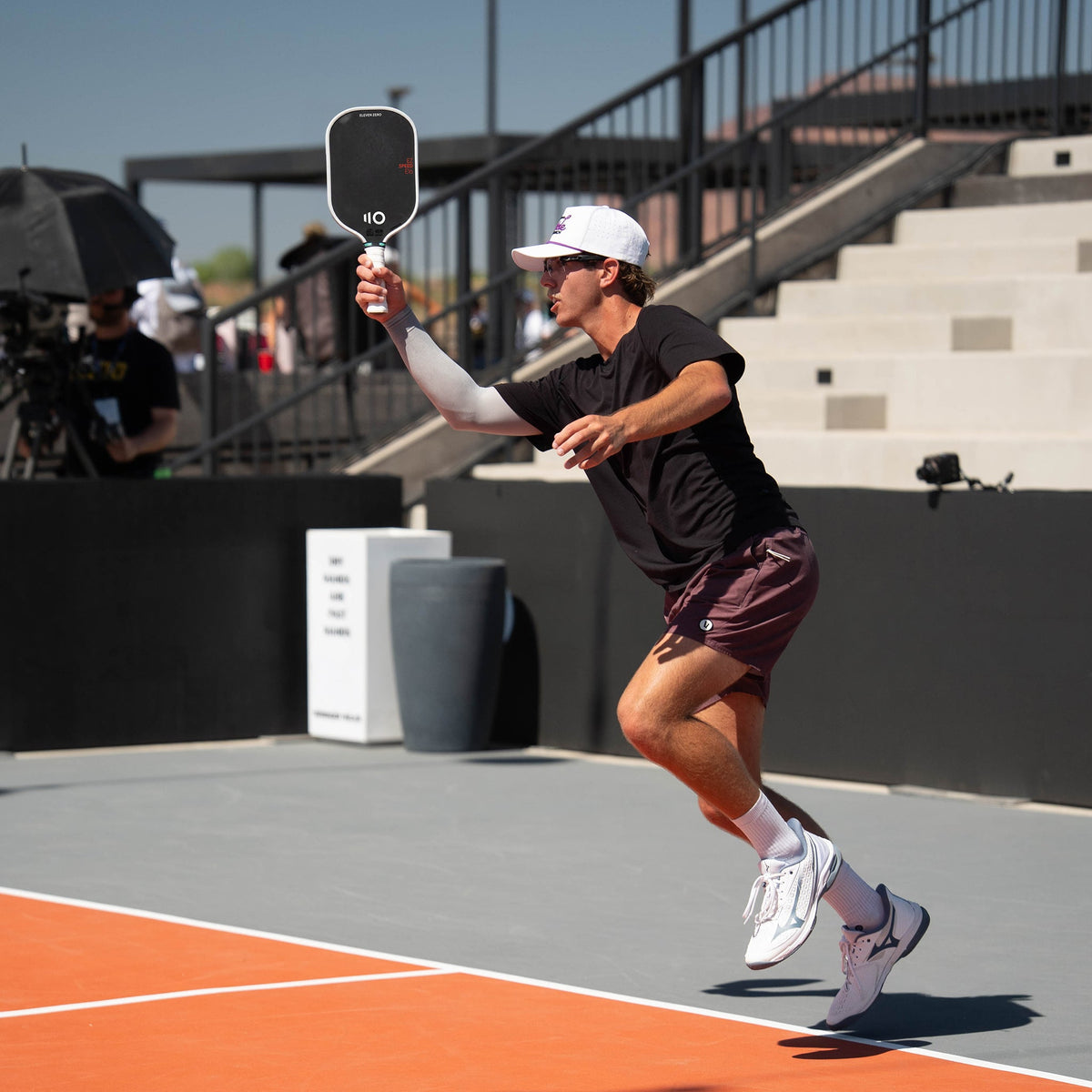
Quick answer: A 5.5 inch handle is the right call if you hit a two handed backhand, and it is a reasonable default for everyone else. USA Pickleball caps a paddle's combined length and width at 24 inches, so every inch of handle is an inch the hitting face does not get. Handle length and grip size are two different specifications, and only one of them can be changed after you buy.
Handle length is one of the few paddle numbers where picking wrong costs you actual shots, and it is also one of the few you cannot fix later with tape or a wrap. Most spec sheets bury it under the shape and the core thickness, which is backwards.
The reason it matters is geometry, not marketing. A paddle has a fixed budget of inches, and the handle and the face are spending from the same account.
The rule that makes this a trade
The USA Pickleball Equipment Standards Manual, Revision 3 from January 2025, sets it out in section 2.E.3: the combined length and width of a paddle, including any edge guard and butt cap, cannot exceed 24 inches, and the length on its own cannot exceed 17 inches. Thickness is unrestricted and so is weight.
Read that as a budget and the whole shape conversation gets simpler. Across the EZ Speed line the elongated models measure 16.5 by 7.5 inches, the hybrids 16.2 by 7.8, and the standard widebody 15.9 by 8.1. All three add to exactly 24. Nobody is getting more paddle than anyone else. They are spending the same 24 inches differently, and the handle takes its share off the top of the length side.
What a longer handle actually buys and costs
The gain is room for a second hand. A two handed backhand needs somewhere for the non dominant hand to sit without the heel of that hand hanging off the butt cap or creeping onto the paddle face. If you play a two hander and your handle is short, you compensate by choking up, which shortens your effective lever and takes power out of the shot you were trying to protect.
The cost is face. Every inch that goes to the handle comes off the hitting surface on the length axis, which pulls the sweet spot down toward your hand and reduces the area available above it. It also moves mass toward the grip, which lowers swing weight. That is a genuine benefit at the kitchen line and a genuine loss on a stretched overhead.
There is a third effect that gets missed. A longer handle on a fixed length paddle means less face length to spread twist weight across, so off center hits on a long handled paddle can feel less stable than the same shape with a shorter handle. If twist weight is new to you, the mechanics are in static weight, swing weight and twist weight.

Handle length is not grip size
These two get conflated constantly and they behave in opposite ways. Handle length is how far the grip runs from the butt cap up to the face. Grip size is the circumference of that handle, measured around it. The EZ Speed line runs a 5.5 inch handle at a 4 1/4 inch circumference across every model.
The practical difference is that one is adjustable and the other is not. Section 2.E.5.a of the standards manual explicitly permits players to change grip size using inserts, grip wraps and manufacturer supplied interchangeable grips. Nothing in the rules lets you extend a handle, and nothing you can buy will do it safely. So buy the handle length you need, and treat circumference as the part you tune afterwards. Our grip size guide covers the measurement.
How to read your own need
- You hit a two handed backhand. Go 5.5 inches or longer, and check that both hands sit fully on the grip with the top hand below the face. This is the clearest case in the sport.
- You came from tennis and still hold a two hander occasionally. Same answer. The habit shows up under pressure even if you think you have dropped it.
- You play one handed and mostly at the kitchen. A shorter handle gives you more face and a slightly higher sweet spot. You are giving up nothing you use.
- You have long fingers or a large hand. Measure before assuming. Hand size drives grip circumference much more than it drives handle length, and the two get treated as one problem far too often.
- You choke up on drives without thinking about it. That is your body telling you the handle is longer than you need, or the swing weight is higher than you want. Test both before you replace anything.
Where we land
Eleven Zero builds the Speed line at 5.5 inches across all six models, and that is a deliberate single choice rather than a menu. A two handed backhand is common enough at 4.0 and above that a shorter handle would quietly exclude a large part of the players we build for, and the players who do not need the length lose very little by having it. If you want the shape conversation that sits alongside this one, we wrote it in paddle shapes explained, and the EZ Speed S14 is the widebody version of the same 24 inches.
Twenty four inches is all anyone gets. The only question is where you spend them.
Frequently asked questions
What is a standard pickleball paddle handle length?
Most paddles built for competitive play use a handle between 5 and 5.5 inches, with elongated models sitting at the longer end. There is no rule governing handle length on its own. The constraint is section 2.E.3 of the USA Pickleball Equipment Standards Manual, which caps combined length and width at 24 inches and length at 17 inches.
Do I need a long handle for a two handed backhand?
Yes, in practice. A two handed backhand needs enough grip for both hands to sit on the handle with the upper hand below the paddle face. On a short handle the upper hand either overlaps the face or you choke up, and choking up shortens your lever and costs you power on the shot.
Is handle length the same as grip size?
No. Handle length is the distance from the butt cap to the face. Grip size is the circumference measured around the handle. Grip size can be changed after purchase with inserts and wraps, which section 2.E.5.a of the standards manual permits. Handle length cannot be changed at all.
Does a longer handle make a paddle worse for off center hits?
It can, because a longer handle on a paddle of fixed overall length leaves less face to distribute twist weight across, and twist weight is what resists the paddle rotating on an off center strike. The effect is modest between similar models and it is one reason to compare twist weight numbers rather than assuming shape alone tells you the answer.
Can I add an extension to make my paddle handle longer?
No. The permitted player alterations listed in section 2.E.5.a cover edge guard tape, weighted tape, manufacturer weight systems, grip size inserts and wraps, interchangeable grips, replacement faces and identification markings. Extending the handle is not among them, and altering a paddle so that it no longer matches the certified version puts it outside its approval.
Share:
How to Test a New Pickleball Paddle in One Session
How to Clean a Pickleball Paddle Without Killing the Grit