



Quick answer: Test a new paddle in one 45 minute session with a fixed order of shots: dinks, resets, drives, third shot drops, overheads, then hands battles. Do the same sequence with your old paddle first so you have something to compare against. Ignore everything you feel in the first ten minutes, because that is your timing catching up, not the paddle telling you anything.
Most players decide about a paddle inside the first ten minutes, and those are the ten minutes with the least information in them. Your hands are still calibrated to the last paddle you swung. Every ball that flies long or lands short in that window says more about your timing than about the frame in your hand.
The fix is not to play more. The fix is to play in a fixed order, with a known reference, and to write down what happened. That takes about 45 minutes and it gives you an answer you can trust.
Why the first ten minutes lie
A paddle does not change once it leaves the factory. The player changes. Your swing timing is tuned to a specific swing weight, and when that number moves, your contact point moves with it until you adjust. A heavier feeling paddle arrives late and your drives sail. A lighter feeling paddle arrives early and your dinks pop. Neither result is a verdict, and both usually disappear within a couple of dozen balls.
This is why the same paddle gets called "unforgiving" by one player on Tuesday and "the best feel I have hit" by the same player on Thursday. Nothing about it moved. Their expectation of when the ball would leave the face did.
What actually differs from paddle to paddle
Four properties account for almost everything you feel. Swing weight is how heavy the paddle feels while it is moving, and it drives your hand speed. Twist weight is how much the face resists rotating when you catch the ball off center, and it decides how playable your misses are. Face stiffness sets how much the ball dwells before it leaves. Shape decides where the mass sits, which loops back into the first two.
The spread inside a single line is narrower than most spec sheets imply. Across the EZ Speed models, swing weight runs from 106 on the S14 to 114 on the E14 and E16, and twist weight runs from 6.2 to about 7. Those gaps are real and you can feel them, but they are gaps of a few points, not different categories of equipment. That is worth knowing before you go hunting for a paddle that will transform your game. USA Pickleball places no restriction on paddle weight at all, so what you are choosing between is a set of engineering trade-offs rather than a legal ceiling.

The session
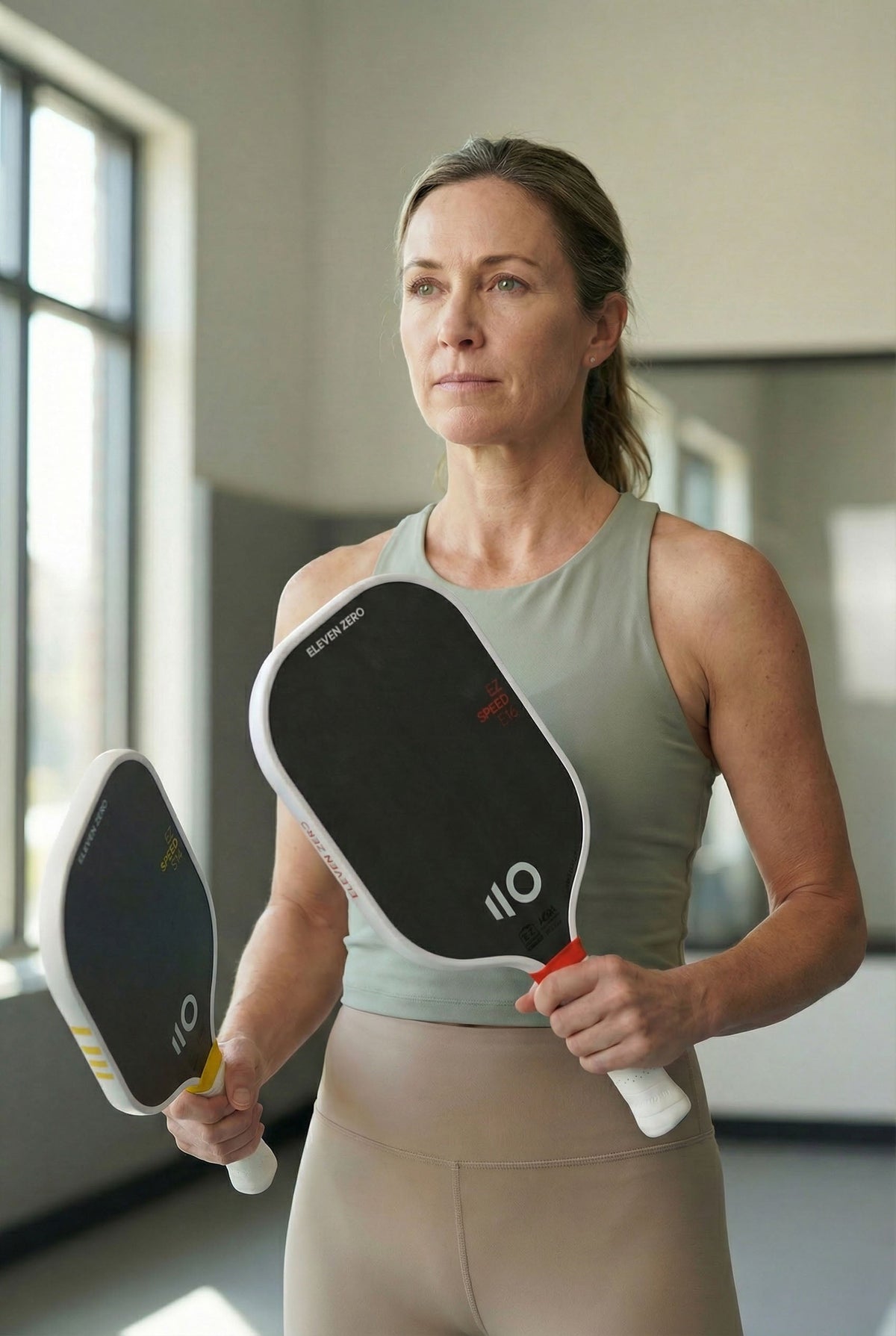
Bring both paddles, the old one and the new one, plus a partner who will feed consistently and not talk about the paddle while you hit. Run each block with the old paddle first, then immediately with the new one, so the comparison is minutes apart rather than days apart.
- Warm up for ten minutes with the old paddle. This is your reference, and it also gets the first ten minutes of recalibration out of the way before any block that counts.
- Dinks, five minutes per paddle. Cross court and straight ahead. You are listening for how much the ball dwells and whether a soft ball sits down or floats.
- Resets from mid court, five minutes per paddle. Have your partner drive at your feet and at your hip. This block is the single best test of twist weight, because your mishits here are the ones that decide points.
- Drives, five minutes per paddle. Ten forehands, ten backhands, same target. Count how many land in. Do not measure how hard they felt.
- Third shot drops, five minutes per paddle. The hardest shot to fake. If your drop percentage falls and stays fallen after the first few, that is a real signal.
- Overheads and hands battles, five minutes per paddle. Overheads expose a swing weight you cannot control. Hands battles at the kitchen expose one you can.
What to write down
Use counts, not adjectives. Drives in versus out. Drops that landed in the kitchen. Resets that stayed low. Speed ups you won. A phone note with six numbers per paddle beats an hour of impressions, because impressions drift toward whichever paddle is newer and more expensive.
Add one line about your arm. If your elbow or shoulder is talking to you after the session and it was quiet before, that matters more than any of the counts. Paddle comfort is worth reading up on separately, and we covered it in arm friendly paddles.
The mistakes that ruin a test
Testing during a competitive game is the most common one. You will play the shot that wins the point rather than the shot that answers the question, and you will blame the paddle for a decision you made. Play drills, not games.
Changing two things at once is the second. A new paddle and a fresh overgrip and added lead tape on the same day gives you no way to attribute anything. Get a baseline with the paddle as it came, then tune. If you do add weight later, the mechanics are in how to add weight to a paddle without ruining it.
Testing with the wrong grip size is the third, and it quietly wrecks everything else. A handle that is too small makes you squeeze, which kills touch on exactly the soft shots you are trying to evaluate. Our grip size guide takes about two minutes to work through.
Where we land
We would rather you run this test than take our word for anything. The EZ Speed line is built so that the paddle you test is the paddle you keep playing with, which is the only reason a 45 minute session is worth doing at all. If your session says our paddle is not the one, we would rather you know that in September than find out in a bracket in March. The EZ Speed E14 is where most players start, and it is certified by both UPA-A and USA Pickleball if you compete under both.
A paddle earns its place in your bag over 45 structured minutes, not over ten flattering ones.
Frequently asked questions
How long does it take to get used to a new pickleball paddle?
Most players recalibrate their timing within one or two sessions, and the largest part of that happens in the first ten minutes of hitting. The paddle itself does not change during this period. Your contact point shifts to match the new swing weight, which is why judgments made in the first few minutes are unreliable.
What should I test first when trying a new paddle?
Start with dinks and resets before you hit a single drive. Soft shots reveal dwell and off center behaviour, which are the properties you cannot recover from with technique. Drives and overheads are easier to adapt to and tell you less about the paddle.
Can I test a paddle properly during a game?
No, because in a game you select the shot that wins the point rather than the shot that answers your question. Run drills with a consistent feeder, in the same order, with your current paddle as the reference. Save games for after you have decided.
Should I add lead tape before I finish testing a paddle?
Test it as it came first. Adding weight changes swing weight and balance at the same time, so if you tune on day one you will never know whether you liked the paddle or the tape. Establish a baseline, then adjust one variable at a time.
How many paddles should I test at once?
Two, and one of them should be the paddle you already play with. Comparing a new paddle against a known reference in the same session is far more accurate than comparing two unfamiliar paddles against each other, and it removes the memory error that creeps in between sessions.

Share:
How to Add Weight to a Pickleball Paddle Without Ruining It
Pickleball Handle Length: Who Actually Needs 5.5 Inches