


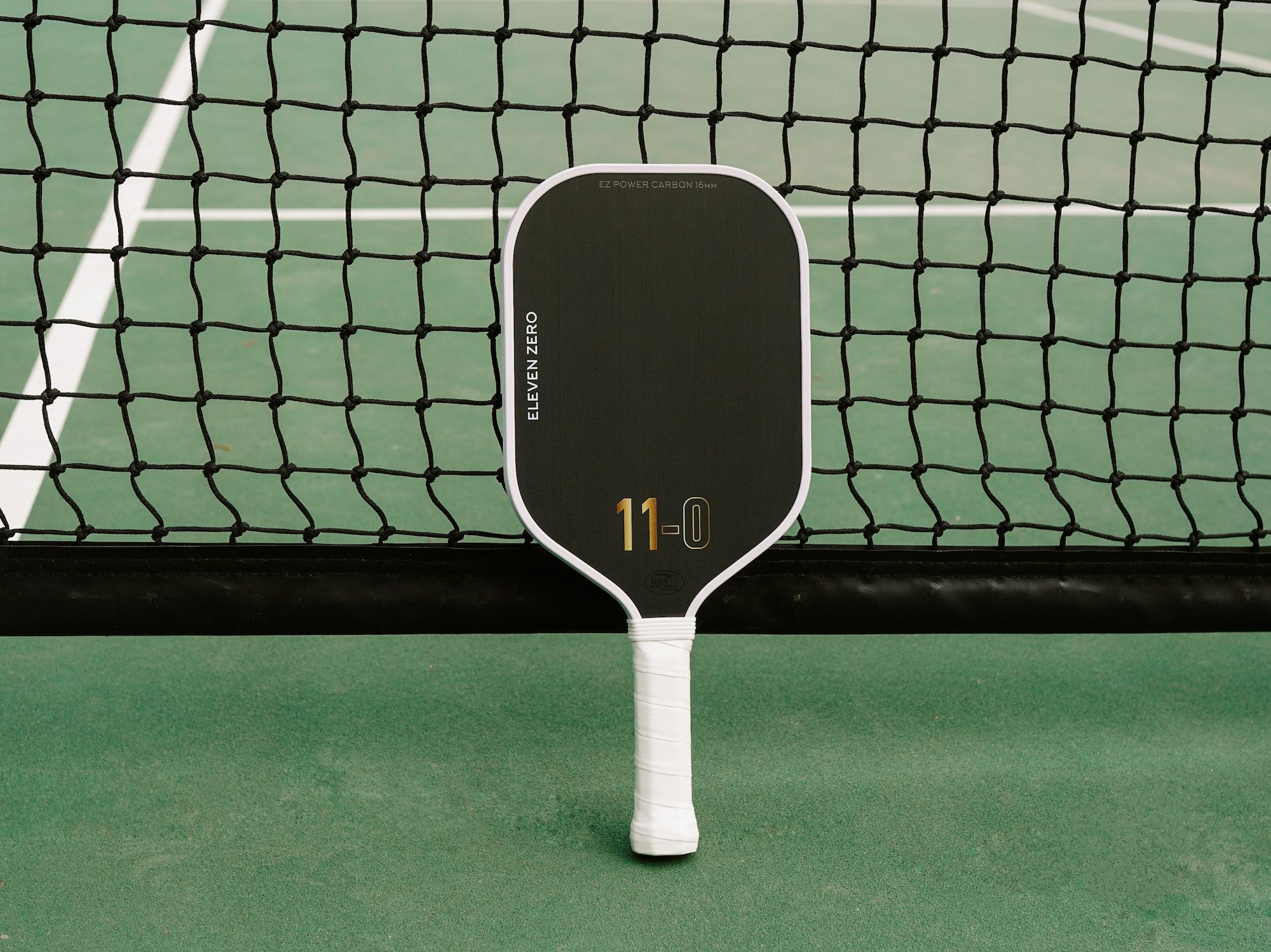

If you’re comparing 14mm vs 16mm pickleball paddles, you’re not really choosing a number, you’re choosing a sensation.
Players describe it like this:
- 14mm: crisp, poppier, faster rebound on counters and hand battles
-
16mm: more plush, calmer touch, steadier blocks, “no-surprises” resets
That doesn’t mean “14mm = power” and “16mm = control” in every single paddle ever made. But it does map to what most players feel in real games, especially at the kitchen line where points are won and lost.
Should I get a 14mm or 16mm paddle?
Choose 14mm if you:
- Win points with speed-ups, counters, punch volleys, and quick hands
- Prefer more feedback (you like feeling the ball)
- Want a crisper response on volleys and flicks
Choose 16mm if you:
- Want easier dinks, drops, and resets
- Care about stability and forgiveness on off-center hits
- Prefer a softer feel and often play fast exchanges at the NVZ line
Best rule: If you lose points on touch and resets, go thicker. If you lose points on reaction counters and pop timing, go thinner.
For Eleven Zero options that map to those choices, compare the EZ Speed H14 and EZ Speed H16.
What “paddle thickness” really means (and what it doesn’t)
When people say 14mm or 16mm, they’re usually referring to the overall paddle thickness, most importantly the core thickness in the face/core/face “sandwich.”
Thickness does not automatically tell you:
- how much spin you’ll get (surface + technique matter more)
- how heavy the paddle is (static weight and balance vary)
- whether it’s “more powerful” (construction and layup can flip expectations)
But thickness does strongly influence how impact feels, especially in the soft game and in fast hands exchanges.
The “feel” differences players notice first
1) Pop vs plush (the sensation everyone talks about)
This is the biggest “14mm vs 16mm” difference.
- 14mm feels poppier: the ball comes off faster on short swings/blocks, counters, punch volleys
- 16mm feels plush: the ball seems to “sit” a fraction longer, giving you a calmer, more controllable response
Important vocabulary:
- Pop = fast rebound on short swings (speed ups, hands battles, counters)
- Power = pace on full swings (drives, serves, overheads)
Many players experience more pop with 14mm, while 16mm can still have plenty of power depending on construction.
2) Dwell time (why resets and dinks feel easier on 16mm)
Players often describe 16mm as having more dwell time, that micro-moment where the ball feels “connected” to the face.
In real terms:
- 16mm helps you absorb pace on blocks and resets
- You get fewer “launchy” mishits when you’re under pressure at the kitchen line
- Touch shots feel less twitchy
If you’ve ever thought, “My paddle feels like a trampoline on blocks,” you’re describing a feel that many players solve by going thicker.

3) Sweet spot and forgiveness (especially in firefights)
A super common reason people switch thickness is forgiveness.
Players often report:
- 16mm feels like a bigger sweet spot
- 14mm can feel more demanding when the pace increases and you’re contacting slightly off-center
That matters most in:
- fast volley exchanges
- defensive resets on the run
- stretch dinks when you’re reaching and not perfectly set
4) Stability and twisting (the hidden reason some paddles feel “easy”)
A paddle that feels stable helps you keep the face angle consistent, especially off-center.
Thicker paddles often feel more stable, but here’s the nuance:
- stability is also heavily influenced by weight distribution and swing weight
- some players make a thinner paddle feel more stable by adding perimeter weighting (e.g., tungsten tape, overgrips)
So: thickness helps, but it’s not the only lever.
5) Hand speed (yes, but usually less than people think)
You’ll hear “14mm is faster in the hands.” Sometimes true, but often the difference players feel is actually:
- overall weight
- balance point
- swing weight
A 16mm paddle that’s well-balanced can still feel quick. Don’t over-index on thickness alone if your main concern is hand speed.
14mm vs 16mm by shot type (what you’ll feel on court)
Dinks & drops
- 16mm: easier to keep the ball low, fewer “floaters,” calmer touch
- 14mm: doable, but you may need more precision to prevent popping the ball up
If your dink game is developing, 16mm often feels like a shortcut to consistency.
Resets (the shot that decides games)
Resets are where 16mm earns its reputation.
- 16mm: better at absorbing pace and dropping the ball into the kitchen
- 14mm: can feel more “springy” on defensive blocks unless your hands are very disciplined
Speed-ups & counters
This is where 14mm often shines.
- 14mm: quicker rebound on counters, punch volleys feel crisp
- 16mm: more muted response; you may generate pace with better technique rather than pure rebound
Drives & serves
This is the “power” zone and it’s more complicated.
- Some players feel 14mm gives easy-access pace
- Others feel 16mm hits heavier because the paddle feels more solid through contact
Construction matters a lot here, so treat thickness as a tendency, not a guarantee.
Blocks at the kitchen line
- 16mm: steadier, more forgiving, fewer accidental pop-ups
- 14mm: can be lethal for punch blocks and aggressive redirections, but less forgiving
Quick comparison table: 14mm vs 16mm feel
|
Trait |
14mm |
16mm |
|
Pop on counters |
Higher / crisp |
More muted |
|
Plush feel / dwell time |
Lower |
Higher |
|
Resets & blocks |
More “launchy” if mistimed |
Easier to absorb pace |
|
Sweet spot feel |
Smaller-feeling |
Larger-feeling |
|
Stability on mishits |
More twisting risk |
Calmer, steadier |
|
Feedback / vibration |
More feedback |
More dampened |
|
Soft game confidence |
Requires more touch |
Often easier |
Doubles vs singles: which thickness fits better?
Doubles (especially modern “kitchen-first” play)
Most players benefit from 16mm in doubles because:
- you take more balls at the NVZ line
- you reset more often
- you block and counter under pressure
Singles (more baseline, more passing, more full swings)
Singles can favor 14mm feel for some players because:
- you hit more drives and passing shots
- you’re doing more quick reaction shots while moving
That said: plenty of singles players still choose 16mm for forgiveness and stability, especially if they value consistency over volatility.
How this applies to choosing an Eleven Zero paddle (simple path)
If you’ve read this far, you’re likely deciding between two experiences:
If you want a 16mm paddle that leans crisp/power
Choose a carbon surface feel more direct response, great for players who still want “bite” in counters and drives.
If you want a 16mm paddle that leans plush/control/spin
Choose an aramid carbon feel softer touch, longer dwell sensation, and a control-forward response for dinks and resets.
Eleven Zero also backs paddles with a 30-day performance guarantee, which is exactly how you should buy a “feel” decision: test it in real games.
Common misconceptions (that cause bad buys)
“16mm always has less power.”
Not always. Some 16mm paddles feel very solid on drives. Power depends on the full build, not just thickness.
“Thickness creates spin.”
Spin is mainly influenced by surface + technique. Thickness can change how confidently you brush and shape the ball, but it’s not the primary “spin dial.”
“14mm is always faster in the hands.”
Often the “speed” people feel is swing weight and balance. Thickness alone isn’t a guarantee.
FAQ
Is a 16mm paddle better than 14mm?
Not universally. 16mm is often easier for touch, stability, and forgiveness. 14mm is often preferred for pop and crisp counters. It’s about your game and what you feel under pressure.
Does 16mm give more control?
Players typically experience more control on dinks, drops, and resets because the response feels calmer and less springy.
Does 14mm give more power or more pop?
Most players associate 14mm more with pop (quick rebound on short swings). Power on full swings can vary by construction.
Which has a bigger sweet spot, 14mm or 16mm?
Many players report 16mm feels like it has a larger sweet spot and more forgiveness, especially during fast exchanges.
Does 16mm reduce vibration?
Often yes, it tends to feel more dampened. Comfort also depends on handle build, edge design, and grip setup.
Should I get 14mm or 16mm for doubles?
Most doubles-focused players prefer 16mm because resets, blocks, and dink consistency are so important in kitchen play.



Share:
What Paddle Thickness Really Changes in Pickleball
Choosing a Paddle Based on Your Playing Style