



Best Pickleball Paddles Under $200 in 2026: Tested & Ranked
You don't need to spend $250 to get a legitimate tournament paddle. Not anymore.
Two years ago, anything under $200 meant you were settling. You were getting last-gen cores, painted-on grit that disappeared in a month, and sweet spots the size of a quarter. The options were basically "cheap" or "real paddle" with nothing in between.
That's completely changed. The under-$200 bracket in 2026 is stacked with thermoformed, carbon-faced paddles built with the same construction techniques that the $250+ flagships use. The gap to paddles costing $80 more has narrowed to the point where, for a lot of players, it's hard to feel. If you're a 3.5+ player who plays three or four times a week, this is the price range where your money goes the furthest.
Here's what we've been playing with, what's actually worth it, and what you should skip.
What to Look for in a Sub-$200 Paddle (And What to Ignore)
At this price point, you should be getting real construction, not marketing language dressed up as technology. Here's the checklist:
Thermoformed Edge
A sealed edge cuts down dead zones around the perimeter and makes the sweet spot feel closer to edge-to-edge instead of concentrated in a hot spot at the center. Every paddle on our list is thermoformed or foam-injected at the edges. In 2026 we'd generally lean toward a sealed-edge paddle once you're spending north of $120, though plenty of good open-edge paddles still exist if the feel suits you.
Carbon Fiber Face
Raw or textured carbon fiber is the standard for spin generation. Ignore the RPM arms race. Spin numbers cluster tightly across the market, and roughly 2,000 RPM is the median, not a quality cutoff. Most modern paddles hit close to their peak spin when they're new, so the magnitude is a weak way to separate one from another. What actually varies is how long the grit lasts and how the face feels under your shots. Some brands use coated carbon (cheaper to produce, loses its bite faster) while others run raw or unidirectional carbon that holds texture longer. Grit durability and feel matter more than the peak number on a spin test or the marketing name they slap on the surface.
Core Construction That Actually Differs
This is where manufacturers differentiate. Polypropylene honeycomb is the standard, but cell size, density, and whether they add foam layers all change the feel dramatically. Smaller cells tend to feel denser and stiffer. Larger cells give you more flex and dwell time. Neither is "better" but they play very differently. A dense, stiff core rewards clean contact with explosive pop. A plush, flexible core gives you more forgiveness and feel on touch shots.
What You Can Ignore
Brand loyalty. Seriously. The paddle market moves so fast that last year's flagship brand might be this year's afterthought. Judge the paddle, not the logo. Also ignore "proprietary technology" names that are just marketing for standard construction methods. If you can't find a spec sheet with actual numbers, that's a red flag.
Best Pickleball Paddles Under $200 for 2026
1. CRBN 1X Power (16mm): $169.99
The CRBN 1X has been the measuring stick in this price range for a reason. Raw carbon fiber face with legitimate grit that holds up over time, a polypropylene honeycomb core with their TruFoam technology, and a sweet spot that's genuinely forgiving on off-center hits.
What it does well: Spin. This paddle grabs the ball and lets you shape it however you want. Drives have real bite, and the spin on third shot drops gives you margin for error you won't get from smoother faces. The feel is dense and responsive without being harsh.
The tradeoff: It's stiff. If you're coming from a plush, flexible paddle, the CRBN 1X can feel boardy on dinks and resets. There's not a lot of give at the kitchen line, which means your touch game needs to be dialed in. Some players love that directness. Others find it punishing on soft exchanges.
Best for: 4.0+ players who prioritize spin and drive power. If you play an aggressive baseline game and want to rip forehands with confidence, this is the move.
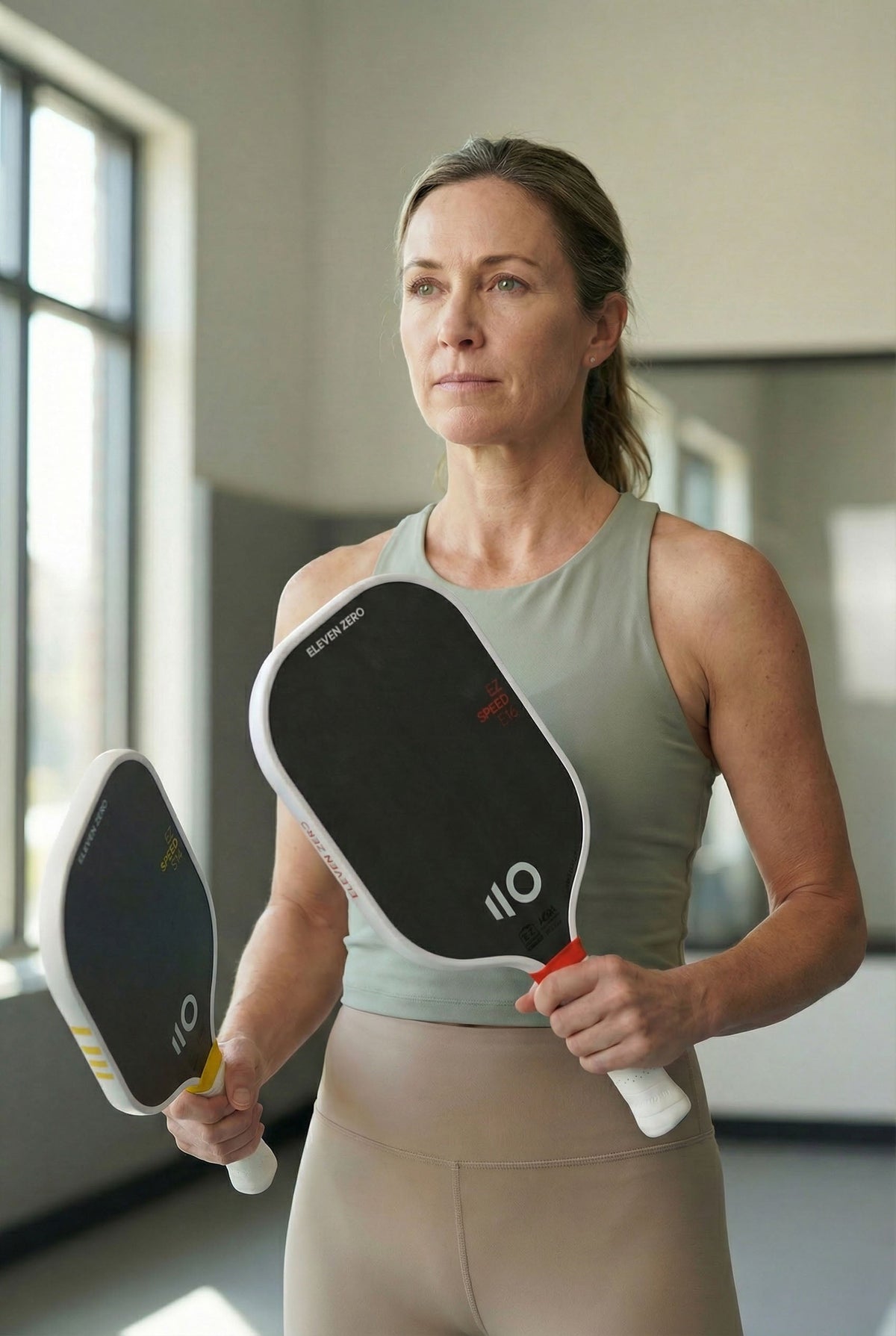
2. Eleven Zero Pro Origin H13: $179.95
Full disclosure: this is our paddle. We're including it because it genuinely competes here, not because we need to sell you on it. If it didn't belong on this list, we'd have a bigger problem than a blog post.
The H13 was designed around what we call a flex-profile feel. Instead of going maximum stiffness for raw power (the current trend), the Pro Origin uses a composite core with 8mm honeycomb cells that compress more evenly across the face. The result is a paddle that gives you real feedback on every shot. You feel the difference between a clean strike and a slight mishit, and that information makes you a better player over time.
The specs that matter:
- Core: Honeycomb + carbon fiber composite, 8mm cell geometry
- Face: Unidirectional soft matte carbon (dwell-focused, not maximum grit)
- Weight: 7.8 oz static (tunes to 8.0 to 8.5 oz with lead/tungsten)
- Shape: Hybrid (16.2" × 7.8")
- Thickness: 13mm
- Certification: UPA-A (PPA tournament approved)
- Construction: Fiberglass throat reinforcement, hard handle pallets, hairpin frame
What it does well: Touch. The flex profile gives you a buttery feel on dinks and resets that stiff paddles simply can't match. The sweet spot is legitimately large thanks to the even compression across the face, so mishits stay playable instead of sailing long. Power is there when you swing through the ball because the 13mm core still has pop, but it's not a paddle that rewards lazy swings with free speed.
The tradeoff: It's a 13mm paddle, which means it's inherently more power-oriented than a 16mm. If you want maximum control and don't care about pop, a thicker core might be more your speed. The soft matte carbon face is tuned for dwell time rather than the grittiest possible surface, so if you chase peak spin numbers a raw-carbon face may feel slightly tackier off the bat. On court the spin holds up well, since the longer ball contact does a lot of the work.
Best for: 3.5 to 4.5 players who want a paddle that rewards good mechanics. If you're the player who lives at the kitchen line, works the dink game, and picks your moments to speed up, the H13 fits your game. Also excellent for players dealing with arm fatigue since the flex profile absorbs vibration better than stiff constructions.
3. JOOLA Ben Johns Hyperion 3 (16mm): $199.99
Right at the ceiling of our budget, the Hyperion 3 is JOOLA's flagship and it delivers flagship performance. The Aero Curve face shape reduces drag, the Response core uses variable stiffness zones, and the Carbon Grip surface provides consistent spin.
What it does well: Everything, competently. The Hyperion 3 is the definition of an all-court paddle. It drives well, it dinks well, it volleys well. There's no glaring weakness, which is exactly what JOOLA designed. The feel is dense and confident without being harsh.
The tradeoff: At $199.99, you're at the absolute top of the sub-$200 range, and the performance gap between this and paddles at $170 has narrowed significantly. You're paying a premium for the Ben Johns name and JOOLA's quality control. Both are worth something, but whether they're worth $30 more than the competition is a personal call.
Best for: Players who want the safest pick possible. If you don't want to think too hard about paddle selection and want something that works for every style, the Hyperion 3 delivers. It's the Honda Accord of pickleball paddles: no one's ever mad they bought one.
4. Selkirk SLK Halo Max: $149.99
The SLK line is Selkirk's way of putting near-flagship construction at a mid-tier price. The Halo Max uses a T700 carbon fiber face, a RevCore polymer core, and Selkirk's EdgeSentry technology for a sealed perimeter. At $149.99, it's arguably the best value on this list.
What it does well: Forgiveness at a price point. The sweet spot is generous, the edge protection means you don't get punished on frame-adjacent shots as badly, and the T700 face has enough grit for solid spin generation. For the money, the construction quality punches above its weight class.
The tradeoff: It doesn't have the refined feel of the paddles above it. The core can feel a little hollow compared to denser constructions, and the power ceiling is lower. You won't be ripping missiles from the baseline the way you can with a CRBN or a hot H13. It's a "does everything okay, nothing amazing" paddle.
Best for: 3.0 to 4.0 players who want legitimate construction without spending $180+. If you're still figuring out your play style and don't want to commit to a power or control specialist, this gives you room to grow.
5. Vatic Pro Prism Flash V2: $139.99
Vatic Pro has made a name for itself by delivering raw carbon performance at prices that make the big brands uncomfortable. The Prism Flash V2 features a thermoformed edge, raw carbon face, and a 14mm core that sits in a nice middle ground between power and control.
What it does well: Value per dollar is hard to beat. The spin numbers are competitive with paddles $60 more expensive, and the raw carbon face has good grit retention. It's poppy off the face and plays faster than you'd expect at 14mm.
The tradeoff: Quality control can be inconsistent. Some units arrive slightly different in weight or balance than advertised. Customer service isn't at the level of the established brands. You're trading brand reliability for paddle performance at a lower price.
Best for: Budget-conscious 3.5+ players who want spin-first performance and are willing to roll the dice on QC for significant savings.
Quick Comparison: Best Pickleball Paddles Under $200
| Paddle | Price | Core Thickness | Face | Weight | Best Attribute | Biggest Tradeoff |
|---|---|---|---|---|---|---|
| CRBN 1X Power | $169.99 | 16mm | Raw carbon | 8.0 oz | Spin generation | Stiff on touch shots |
| Eleven Zero H13 | $179.95 | 13mm | Matte carbon | 7.8 oz | Feel & forgiveness | Less raw grit than CRBN |
| JOOLA Hyperion 3 | $199.99 | 16mm | Carbon Grip | 8.2 oz | All-court balance | Price at the ceiling |
| Selkirk SLK Halo Max | $149.99 | 16mm | T700 carbon | 7.9 oz | Value & forgiveness | Lower power ceiling |
| Vatic Pro Prism Flash V2 | $139.99 | 14mm | Raw carbon | 7.8 oz | Price-to-spin ratio | QC inconsistency |
What About Pickleball Paddles Under $100?
If $200 is more than you want to spend (no judgment, we've all been there), there are legitimate options under $100 that aren't just glorified wooden paddles.
Selkirk SLK Evo Soft ($79.99): Selkirk's budget line still benefits from their construction expertise. The Evo Soft is a 16mm polymer core with a fiberglass face that plays plush and forgiving. It's an excellent starter paddle, and a fine pick for players still deciding whether pickleball is "their thing" or who play once or twice a week. It's a genuine paddle, not a toy.
HEAD Radical ($89.99): HEAD brought their racquet sport expertise to pickleball and the Radical delivers a solid, no-frills experience at a fair price. Comfortable grip, decent sweet spot, and enough performance to get you through your first year of competitive play.
The honest truth: the jump from a sub-$100 paddle to a $150-$200 paddle is the single biggest performance upgrade you can make in your equipment. It's not incremental. The construction quality, face technology, and sweet spot consistency are in different leagues. If you're playing three or more times a week and you're at 3.5+, the upgrade is worth every dollar.
Final Verdict: Best Pickleball Paddle Under $200 in 2026
There's no single "best" here because your game and your preferences matter more than any reviewer's opinion. But here's how we'd break it down:
Best for spin-first attackers: CRBN 1X Power. The raw carbon face and stiff, dense feel reward aggressive play. If you're driving from the transition zone and pulling your opponents off the court with angled topspin, this is your paddle.
Best for feel and all-court play: Eleven Zero Pro Origin H13. The flex-profile construction gives you feedback and forgiveness that stiff paddles can't match. If you play a patient, strategic game and want a paddle that makes you feel every shot, this is the pick.
Best safe choice: JOOLA Hyperion 3. No weaknesses, premium brand, plays well for everyone. The reliable choice if you want to buy once and not think about it.
Best value: Selkirk SLK Halo Max or Vatic Pro Prism Flash V2. Both deliver construction quality well above their price points. The Selkirk is safer; the Vatic has higher upside if you get a good unit.
At the end of the day, the best paddle is the one that fits your game. Demo if you can. And if you can't demo, buy from somewhere with a solid return policy. The paddles in this bracket are close enough in quality that personal preference will always be the deciding factor.
Play more. Overthink less. See you on the court.
Share:
Best Pickleball Paddles for Tennis Elbow (2026): Arm-Friendly Guide
Pickleball Accessories You Actually Need (2026): Skip the Junk