


Quick answer: Delamination is the bond between a paddle's face and its core coming apart. The loose face starts behaving like a trampoline, so the paddle gets hotter and less predictable than the paddle that was tested and approved. You can usually hear it before you can see it: tap along the face with a knuckle and listen for a zone that sounds hollow or rattly against the rest. A paddle that has delaminated is not broken in, it is broken, and it is no longer the paddle on the approved list.
Every paddle sold today is a sandwich. A core sits in the middle, a face is bonded to each side of it, and an edge guard wraps the perimeter. The bond between face and core is what makes the whole thing behave like one object instead of three. When that bond fails in a patch, the face over that patch is no longer supported, and it starts to flex on its own.
That is delamination, and it is the single failure that changes a paddle's performance the most while looking almost normal from two feet away.
What a loose face actually does to the ball
An unsupported face stores and returns energy the way a drum skin does. Instead of the ball compressing against a stiff surface backed by a core, the face itself deflects and springs back into the ball on the way out. The result is more exit speed for the same swing, a duller or louder sound depending on where you hit, and a shot that goes long when you thought you blocked it softly.
This is why delaminated paddles get described as feeling powerful. They are powerful. They are also outside the window the paddle was certified in, which is the part the marketing around hot paddles tends to skip.
The numbers the testing bodies actually measure
Both sanctioning bodies set limits that a delaminated face will fail. The UPA-A runs an Average Deflection Force test and requires that both faces measure 46 pounds or more at ambient conditioning between 70 and 75 degrees Fahrenheit. That is a stiffness floor, and a face that has lifted off its core deflects under less load than it did new. UPA-A also caps spin at 2200 RPM at any angle.
USA Pickleball approaches the same problem from the power side. Its Paddle-Ball Coefficient of Restitution test fires a ball at a clamped paddle at roughly 60 miles per hour from an air cannon and derives a restitution value from the inbound and outbound speeds. The not-to-exceed limit was 0.44 when the test came into force on November 1, 2024, and tightened to 0.43 on November 1, 2025. Paddles that sat above the initial threshold were sunset out of sanctioned play on July 1, 2025.
Read those two together and the picture is clear. One body sets a floor on how stiff the face has to be, the other sets a ceiling on how much energy comes back off it. Delamination pushes a paddle the wrong way through both.

Why it happens at all
Three things drive it, and none of them are exotic. The first is heat, because the adhesive holding face to core is the part of a paddle least happy in a hot car. The second is impact fatigue, since every ball loads the bond in shear and a few hundred thousand hits find the weak spot eventually. The third is the one nobody advertises: a build that was engineered close to the edge of the power limit has very little room to spare when the bond starts to give.
That third one is worth sitting with. A paddle that leaves the factory near the ceiling and then delaminates goes over the ceiling. A paddle built to sit at the limit and hold there degrades into a paddle that is still legal. Same category, different engineering intent, and the difference only shows up in month six.
How to check a paddle like someone who knows
- Tap the whole face with a knuckle. Work in a grid, corner to corner. A healthy paddle gives one consistent tone. A hollow, rattly or noticeably deeper note over one zone is the tell, and it usually shows up near the top third or along the edges first.
- Compare against a second paddle. Your ear calibrates fast when it has a reference. If you own two, tap them back to back before you decide anything.
- Watch for blocks that fly. A soft reset that sails long when your technique has not changed is a power increase you did not ask for.
- Run a fingernail along the edge guard seam. A face that has begun to lift will sometimes show a hairline gap or a soft spot where the guard meets the face.
- Press the face with a thumb. Any area that gives more than the rest, or that clicks, is a bond that is no longer continuous.
- Take it out of play once you find it. A delaminated paddle in a rec game is a paddle that no longer matches what anyone else on the court is holding.
What it is not
A paddle that feels different after a month of play has usually not delaminated. Grit wears, grips pack down, and your own timing moves, and those account for most of what players call a paddle changing. Our post on how long a paddle actually lasts covers the ordinary version of that, and cleaning the face properly fixes more complaints than any repair does.
Delamination is louder than any of that. It is a sound change and a power change together, localized to a zone, and it does not reverse.
Where we land
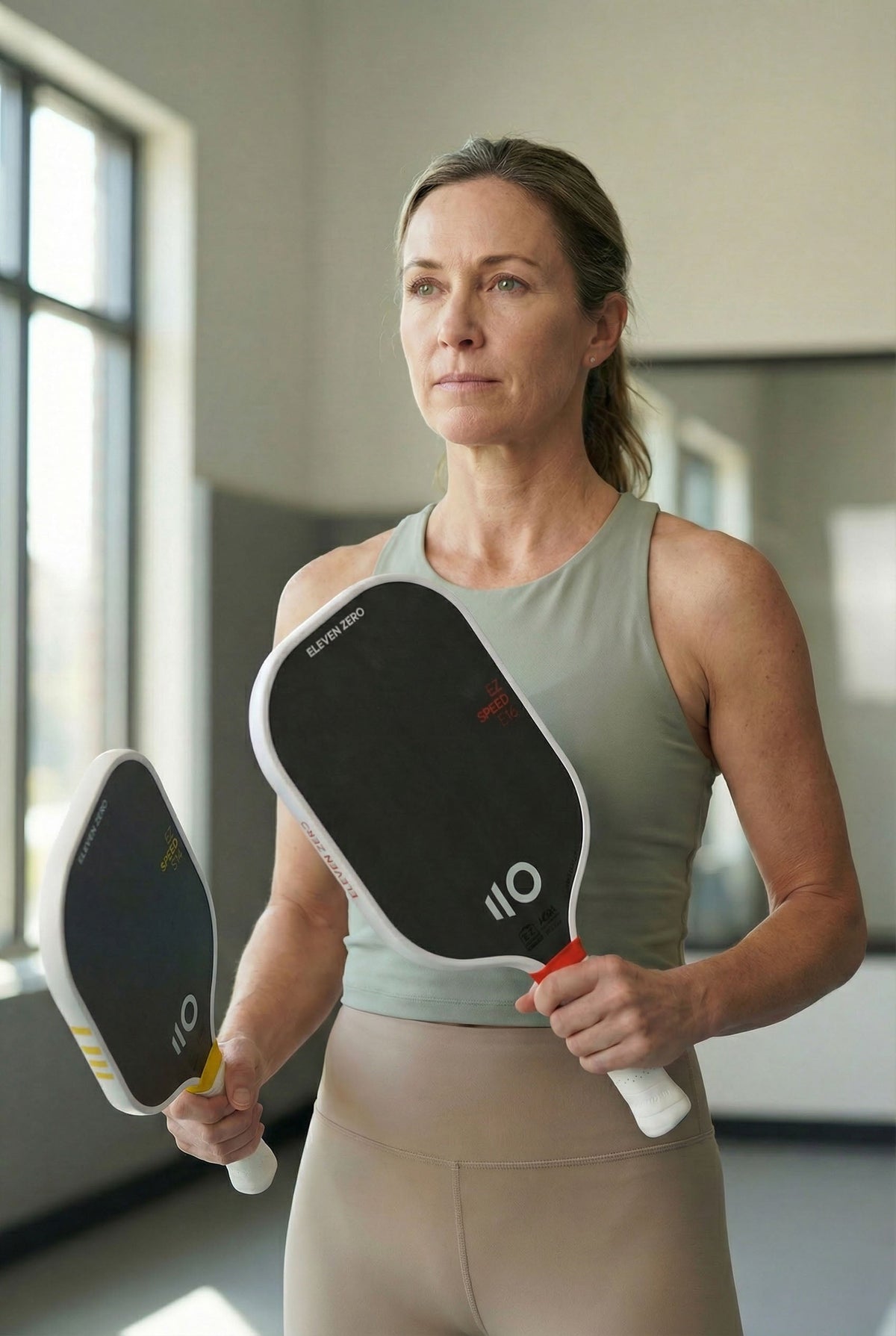
We build for the bond, because the bond is what decides whether a paddle is still the paddle you bought a season later. The Speed core is a triple-density build: an EPP center for energy transfer, a soft EVA layer for feel, and a harder edge foam at the perimeter for stability, with the TPU serving only as the edge guard. The engineering target is to sit right up at the legal limit for power and spin and to stay there, rather than to start above it and drift. The EZ Speed E14 is approved by both UPA-A and USA Pickleball, and the EZ Speed E16 carries UPA-A approval, which is the standard the PPA Tour runs on.
If a paddle suddenly gets better at putting balls into the back fence, it did not improve.
Frequently asked questions
What is paddle delamination in pickleball?
Delamination is the failure of the adhesive bond between a paddle's face and its core. The face over the failed area is no longer supported, so it flexes independently and returns more energy to the ball than the paddle did when it was tested.
How do you tell if a pickleball paddle is delaminated?
Tap across the whole face with a knuckle and listen. One consistent tone is healthy. A hollow, rattly or deeper note over one zone points to a bond that has failed there. Balls flying long off soft blocks and a soft spot under thumb pressure are the other two common signs.
Is a delaminated paddle legal to play with?
No. Certification applies to the paddle as tested, and a delaminated face no longer meets the stiffness and power conditions it was approved under. UPA-A requires both faces to measure 46 pounds or more on its deflection test, and USA Pickleball caps restitution at 0.43 under its PBCoR standard.
Does delamination make a paddle more powerful?
Yes, and that is the problem. The unsupported face acts like a trampoline and adds exit speed the paddle was never certified to produce, which is unfair to everyone else on the court and unpredictable for the person holding it.
Can a delaminated pickleball paddle be repaired?
Not in any way that restores it to a certified condition. Adhesive injected from outside cannot rebuild a uniform bond between face and core, and a repaired paddle has no test behind it. Replace it and keep the old one for wall drills at home.
What causes a pickleball paddle to delaminate?
Heat is the biggest accelerator, which is why a hot car trunk is the worst place to store a paddle. Repeated impact fatigues the bond over time, and a build engineered close to the power ceiling has less margin when the bond begins to give.
Share:
Indoor vs Outdoor Pickleballs: Why Your Paddle Feels Different