


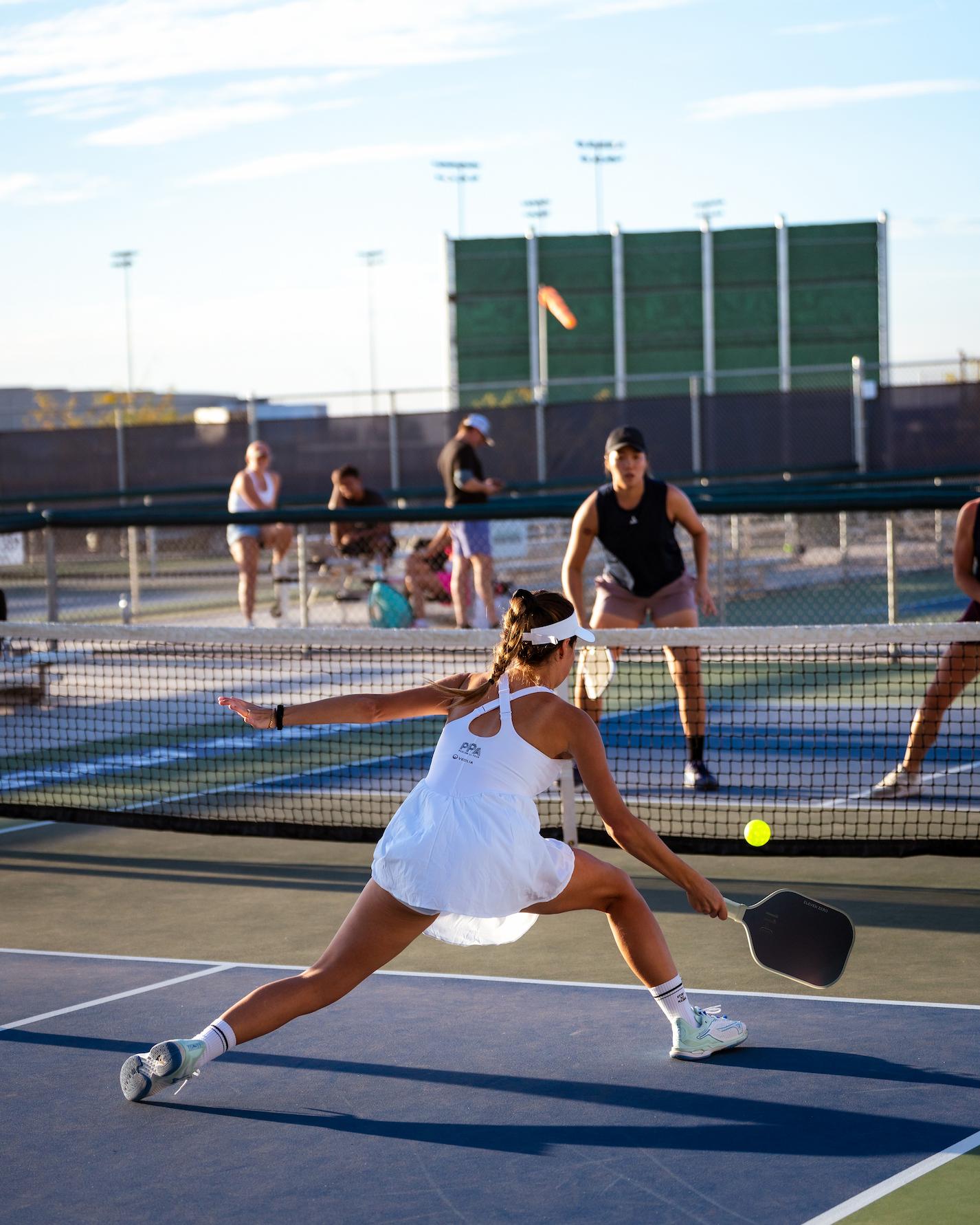
Quick answer: Most pickleball paddles last somewhere between three months and two years, depending on how often you play and how well the paddle is built. They rarely fail visibly. The core loses pop, dead spots spread across the face, and the sound goes flat on a swing you have hit a thousand times. If your shots have been landing short for weeks and your technique has not changed, test the paddle before you blame yourself.
There is a pattern that catches almost everyone eventually. Your drives start landing a foot shorter than they used to. Your counters feel late and your put-aways sit up, so you spend three weeks drilling because you are sure your mechanics broke. Then you borrow a friend's paddle and every shot comes back.
The paddle was dying the whole time. Paddles fail quietly, with no snapped string or cracked frame to announce the end, so most players blame themselves first and suspect their equipment last. Knowing what wears out, and what a dying paddle sounds like, can save you weeks of second-guessing a swing that was never the problem.
What actually wears out
A paddle is a spring you swing. Every contact compresses the core and flexes the face, and each one takes a small, permanent toll.
The core usually goes first. In most paddles it is a polymer honeycomb, and thousands of impacts slowly crush the cells behind the sweet spot. A compressed core returns less energy, so the same swing produces a slower ball, which you experience as lost pop. Some constructions pass through a strange middle phase where the crush briefly makes the paddle hotter before it goes dead. That has consequences beyond feel, and we covered them in our post on whether your paddle is still legal.
The face wears too. A carbon face gets its snap from resin holding stiff fibers in place, and repeated flexing works microscopic fatigue into that resin until the snap softens. When core crush is local instead of even, you get a dead spot, a patch of the face that returns almost nothing. And the grit that generates your spin is an abrasive surface doing an abrasive job, so it gradually wears itself smooth.

How long paddles really last
Honest ranges come with an honest caveat: this is rough guidance from watching paddles age, not lab data. Build quality moves these numbers as much as court time does.
- Casual play, once a week or less: roughly one to two years.
- Regular play, two to four sessions a week: roughly six months to a year.
- Heavy play, daily sessions or tournament training: three to six months, sometimes less for hard hitters.
Cheaply built paddles sit at the bottom of every range, and a thin face over a soft core can go dead in weeks under a strong player. Construction is the variable most buyers never see, which is why we wrote about it separately in our post on what thermoformed paddles actually cost you.
The dead paddle checklist
Run through this list before you book a lesson to fix a swing that is not broken.
- The sound changed. A healthy paddle has a crisp pop. A dying core sounds dull and flat, more thud than crack. You have heard this paddle thousands of times, so trust your ears when they report something new.
- Less pop on the same swing. Drives land short and volleys that used to end points come back at you. If your depth disappeared and your technique did not change, the paddle is returning less than it used to.
- Dead zones you can map. Tap a ball gently across the face in a grid. A healthy face sounds even everywhere, while a crushed patch answers with a lower, deader note whose outline you can usually trace.
- Visible damage. Press the face with both thumbs and look for soft spots, ripples, or cracks near the throat. If one area gives more than the rest, the core beneath it has crushed.
- Spin fell off. The texture has worn smooth, and balls slide off the face instead of biting into it.
One symptom is a suspicion. Two or more is a verdict, and the fastest confirmation is ten minutes with a fresh unit of the same model.
What kills paddles early
Court time earns wear honestly. These shortcuts do not.
- Hot cars. A trunk in summer reaches temperatures that soften the resins and adhesives holding a paddle together. Heat can age a paddle faster than play does, and it is the classic unforced error of paddle ownership.
- Paddle clashes. Net exchanges and partner collisions crack edges, and edge damage keeps spreading under normal play afterward.
- Moisture. Wet balls, damp courts, and a sweat-soaked bag work water in past the edge guard, and foam and water make a bad pairing.
- Drops on concrete. A single corner drop can start an invisible crack. The paddle plays on, slightly worse, and you inherit the difference.
When to replace it
Use a simple rule. If the paddle shows two or more checklist symptoms and your results have dipped for more than a couple of weeks, replace it. Nursing a dying paddle rewires your timing, because you start swinging harder to buy back the lost depth, and that compensation follows you onto the next paddle as a habit you have to unlearn.
Competitive players carry a second risk that has nothing to do with feel. Because some constructions run hotter mid-crush before they die, an aging paddle can drift past the legal limit while feeling fantastic. That is exactly why the stricter certification standard re-tests paddles after deliberately wearing them in, a process we explained in our post on what certification really means.
Where we land
We built the EZ Speed line around the part of this problem you cannot see in a store. The EZ Speed uses a triple-density foam core: a dense EPP center that resists compression, a softer EVA layer around it for feel, and hard edge foam for stability, all under a thermoformed carbon face. The foam core is tuned to fade gradually as it ages instead of spiking hot, and that is a design goal rather than a lab-certified lifespan figure.
If your last paddle died young and you would rather not repeat the experiment, the EZ Speed E14 is where we would start. It is an elongated 14 millimeter paddle at 7.8 ounces, certified under both USAP and UPA-A.
Your swing did not fall apart overnight. Your paddle might have.
Frequently asked questions
How long do pickleball paddles last?
Most paddles last between three months and two years. Casual players who play once a week often get one to two years, regular players get six months to a year, and daily or competitive players can wear one out in three to six months. These are rough working ranges rather than lab figures, and build quality moves them substantially.
How do I know if my pickleball paddle is dead?
Listen and compare. A dying paddle sounds dull instead of crisp, loses depth on the same swing, and often develops dead spots you can find by tapping a ball across the face and listening for a flat note. Soft spots or cracks you can see or feel confirm it. Two or more symptoms together usually mean the paddle is done.
What wears out first on a pickleball paddle?
Usually the core. Thousands of impacts compress it, and a compressed core returns less energy, which players feel as lost pop. The face fatigues more slowly, and the spin texture gradually wears smooth the way any abrasive surface does.
Does leaving a paddle in a hot car damage it?
Yes. A car trunk in summer reaches temperatures that soften the resins and adhesives inside a paddle, which can age the core and face faster than play alone. Heat is one of the most common reasons paddles die early.
Can an old pickleball paddle become illegal?
Some constructions can. Certain cores briefly get hotter as they crush, which can push a once-legal paddle past the power or spin limit before it goes dead. That is why UPA-A, the PPA Tour standard, re-tests paddles after destructive break-in instead of only measuring them new.
Do EZ Speed paddles need a break-in period?
No. The EZ Speed line is built to play right out of the box, and its foam core fades gradually as it ages. If a new paddle feels different during your first sessions, that is your timing adjusting to the paddle, not the paddle changing underneath you.
Share:
How to Spot a Counterfeit Pickleball Paddle, and Why It Is More Than a Knockoff
Does an expensive pickleball paddle actually make you better?