


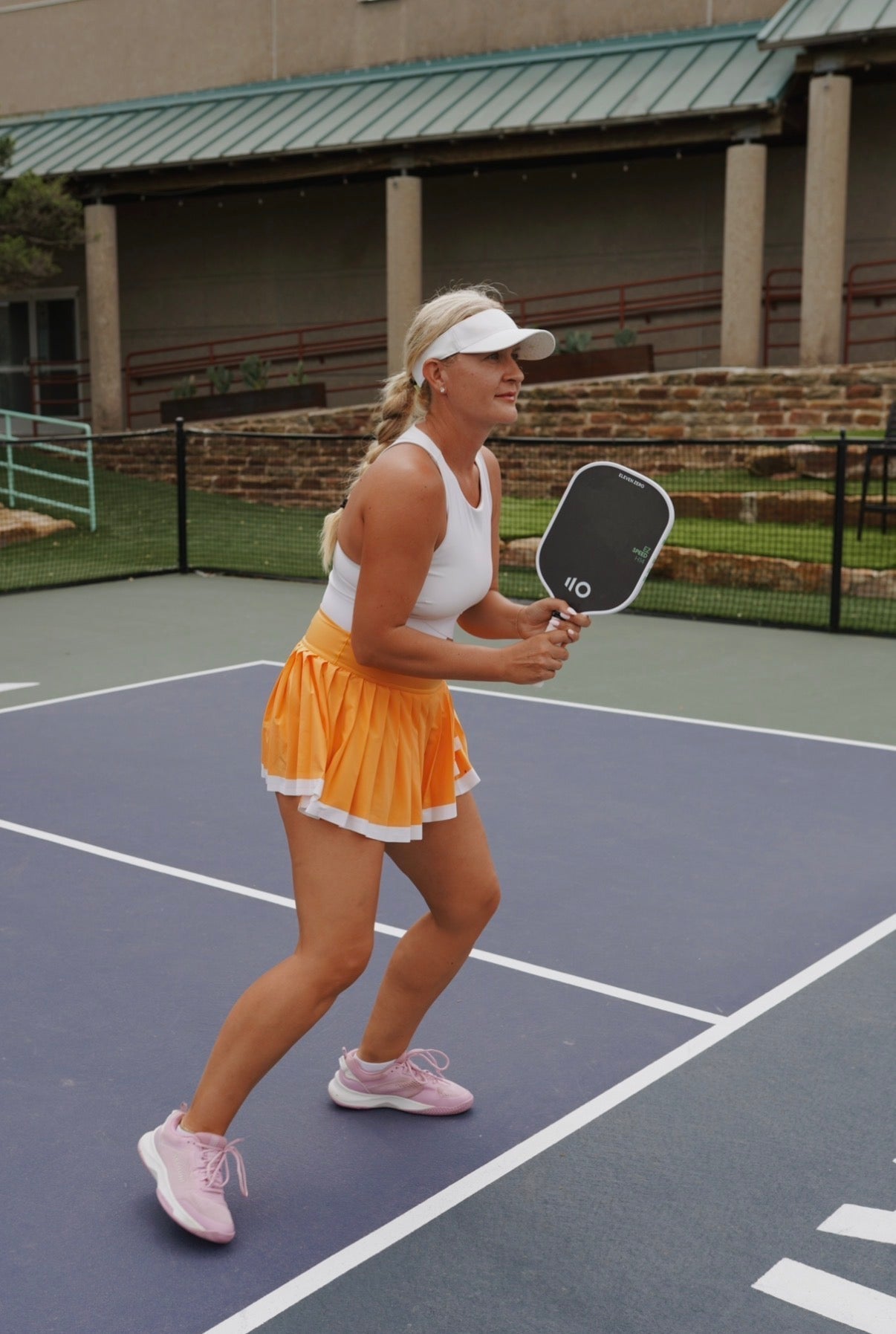
Quick answer: Mostly no. Independent paddle-lab databases covering more than 400 paddles show the raw performance spread across the whole market is small, roughly 2.5 percent in power and about 150 RPM in spin. A premium paddle buys consistency between units, performance that holds over the paddle's life, and certification you can verify. It does not buy skill, and it will not raise your rating by itself.
We sell premium paddles, so you might expect this post to end with a reason to spend more. Here is the honest version instead: an expensive paddle will not make you better at pickleball, at least not in the way the marketing implies.
The raw performance gap between a budget paddle and a flagship is smaller than almost anyone believes. The things a premium paddle genuinely buys are real, but none of them add points to your rating. Once you can tell those two categories apart, the buying decision gets much easier.
The performance gap is smaller than you think
Every legal paddle lives under the same ceiling. Both certification standards cap power and spin, so no approved paddle is allowed to hit harder or grip the ball beyond what the rules permit, whatever it costs. We walked through how those caps work in our post on what certification really means.
Under that ceiling, the field is tightly packed. Independent paddle-lab databases now cover more than 400 paddles with standardized machine testing, and the spread they show across the whole market is narrow: roughly 2.5 percent separating the most powerful paddles from the least, and about 150 RPM separating the top spin producers from the bottom. For scale, 150 RPM is smaller than the swing-to-swing variation in your own contact on an average day.
That is what a capped, mature category looks like. The marketing is loud precisely because the engineering differences are quiet.
What actually makes you better
Rating gains come from repetitions. Footwork, a reliable third shot, patience in dink rallies, and returns that land deep will move you from 3.5 to 4.0, and a coach will get you there faster than any face material. A 4.0 playing a tired budget paddle beats a 3.5 holding a flagship, and it will not be close.
Equipment can hold you back, which is different from making you better. A dead core, a cracked face, or a paddle that no longer matches the rules can cost you real points. Past basic competence and a functioning paddle, though, the returns on spending shift from performance to certainty.

What premium actually buys
- Consistency between units. Tight quality control is one of the quietly expensive parts of building paddles, and it is what makes the unit you receive match the sample that was certified and the paddle the reviewers tested. Loose tolerances are where budget construction saves its money.
- Performance that holds. Cheap cores and faces can fade within months, while premium materials are engineered to keep their response deep into the paddle's life. We broke down the construction side of this in our post on what thermoformed paddles actually cost you.
- Certification you can verify. Both approved-paddle lists are public. A premium brand can show you its models on them, including the stricter standard that re-tests paddles after break-in, and dual-certified models are legal at any event.
- Support behind the purchase. When a defect shows up, there is a brand on the other end that answers and makes it right.
Notice what is missing from that list. Nothing on it adds a shot to your game or a digit to your rating. Premium buys certainty about the paddle, not ability in the player.
When a budget paddle is the right call
If you are new to the sport, buy the modest paddle without guilt. You do not yet know whether you prefer an elongated or standard shape, a head-heavy or balanced swing, a thicker or thinner core, and those preferences will change as your game forms. A budget paddle answers those questions while your swing is still deciding what it wants, and the performance you give up is a rounding error at that stage. Put the difference toward a few lessons, which will do more for your game than any paddle ever will.
The same logic applies if you play a few times a month. At that volume a paddle wears slowly, fade resistance barely matters, and the tightly packed performance field means you are giving up almost nothing.
When premium is worth it
Premium starts earning its keep in three situations. The first is volume: if you play several times a week, you have probably already felt a paddle die under you, and a paddle engineered to hold its performance ends that cycle of replacing and re-adjusting. The second is competition: if you play sanctioned events, certification coverage stops being abstract, and a dual-certified paddle is legal wherever the bracket takes you. The third is consistency: if you have ever bought a second unit of a paddle you loved and found it played like a stranger, you already know what tight quality control is worth.
Where we land
The EZ Speed line is a premium product, and we will not pretend it plays outside the legal band, because nothing approved does. What we engineer for is the list above. The line is built on a triple-density foam core under a thermoformed carbon face, designed to hold its performance across the paddle's life instead of spiking hot and fading, and the E14 and S14 carry certification under both USAP and UPA-A so one paddle is legal at any event you enter. Those are promises about the paddle, and they are the honest reasons to pay for one.
If that certainty is what you are shopping for, start with the EZ Speed E14, an elongated 14 millimeter paddle at 7.8 ounces. If you are shopping for a better rating, book the lesson first. We mean that.
No paddle has ever learned a third shot drop on behalf of its owner.
Frequently asked questions
Are expensive pickleball paddles worth it?
Only conditionally. Independent paddle-lab databases covering more than 400 paddles show a raw performance spread of roughly 2.5 percent in power and about 150 RPM in spin across the market. A premium paddle is worth it for unit-to-unit consistency, performance that holds over its life, and certification coverage, not for raw output a budget paddle lacks.
Do expensive paddles have more power and spin?
Barely. Certification caps both power and spin, so every approved paddle lives under the same ceiling, and machine testing across the market shows differences small enough that the variation in your own contact is often larger.
Will a better paddle improve my rating?
Not by itself. Rating gains come from repetitions, coaching, and shot selection. A paddle can stop holding you back if your current one is dead or badly built, but past that point improvement comes from the player.
What paddle should a beginner buy?
A modest one. New players have not yet formed preferences for shape, weight, or balance, and those preferences change as the game develops. Buy a budget paddle, put the difference toward lessons, and upgrade once you know what you like.
When should I upgrade to a premium paddle?
Upgrade when you play often enough to feel a paddle fade, when you compete in events where certification matters, or when you want your next unit to play exactly like your last one. Upgrade for consistency and durability, not for a promised jump in performance.

Share:
How long does a pickleball paddle actually last?
UPA-A vs USAP: Which Paddle Certification Do You Need?