



Ask any 4.5+ player what separates a 3.5 from a 4.0, and most of them will say the same thing: the third shot drop. It's the single hardest shot to master in pickleball, and it is the shot we see hold players back more than anything else at our events. It is also the single most valuable once you do. (Not sure if your paddle is holding you back? Check our guide to the best paddles for intermediate players.)
If you can consistently land a soft, arcing shot from the baseline into your opponent's kitchen (the third shot of the rally), you neutralize their positional advantage and give yourself time to move forward. If you can't, you're stuck at the baseline while they control the net. And the net wins.
Why It's Called the "Third Shot"
Quick count:
- First shot: The serve.
- Second shot: The return of serve.
- Third shot: The serving team's next shot, and the most critical decision point in the rally.
After the serve and return, the receiving team is already at or moving toward the kitchen line (they had time to move forward during the return). The serving team is stuck at the baseline because of the double-bounce rule: they had to let the return bounce.
This creates the fundamental asymmetry of pickleball: the receiving team starts every point with a positional advantage. The third shot is how the serving team erases it.
Drop vs. Drive: When to Use Each

The third shot drop isn't always the right play. Understanding when to drop and when to drive is part of the skill.
Drop when:
- Both opponents are at the kitchen line. A drive into two set players at the net is a low-percentage play, they have angle, position, and time. A drop forces them to hit up, giving you time to advance.
- The return is deep. You're far from the net with a lot of court to cover. A drop buys you the time to move forward. A drive just starts a firefight you'll lose from 30 feet back.
- You need to reset the point. Things are chaotic, you're out of position, and you need a neutral ball. The drop is your reset button.
Drive when:
- The return is short or high. If you're inside the baseline and the ball is above net height, you have a green light. A well-placed drive can create a weak return or outright winner.
- One opponent is still transitioning. If someone's caught in no-man's land (between the baseline and kitchen), a drive at their feet is devastating.
- You want to change the pattern. If you've been dropping every third shot, a surprise drive keeps opponents honest. Predictability is a weakness.
The best players mix both. The threat of the drive makes the drop more effective, and vice versa. If opponents know you're always dropping, they creep forward and take it early. If they know you're always driving, they set up for the counter.
How to Hit the Third Shot Drop

The Setup
- Split step as the return is coming. Read the ball early, where it's going, how deep, how fast.
- Get behind the ball. Footwork first, always. If your feet aren't set, your drop won't be consistent. Move to the ball, set up, then swing.
- Open stance is fine. Unlike a drive, you don't need a full rotation. A relaxed, open stance with good balance works perfectly for drops.
The Swing
- Paddle face open. Angle the face slightly upward, you're lifting the ball, not pushing it forward.
- Swing from the shoulder, not the wrist. Wrist involvement introduces inconsistency. A pendulum motion from the shoulder is more repeatable and easier to control under pressure.
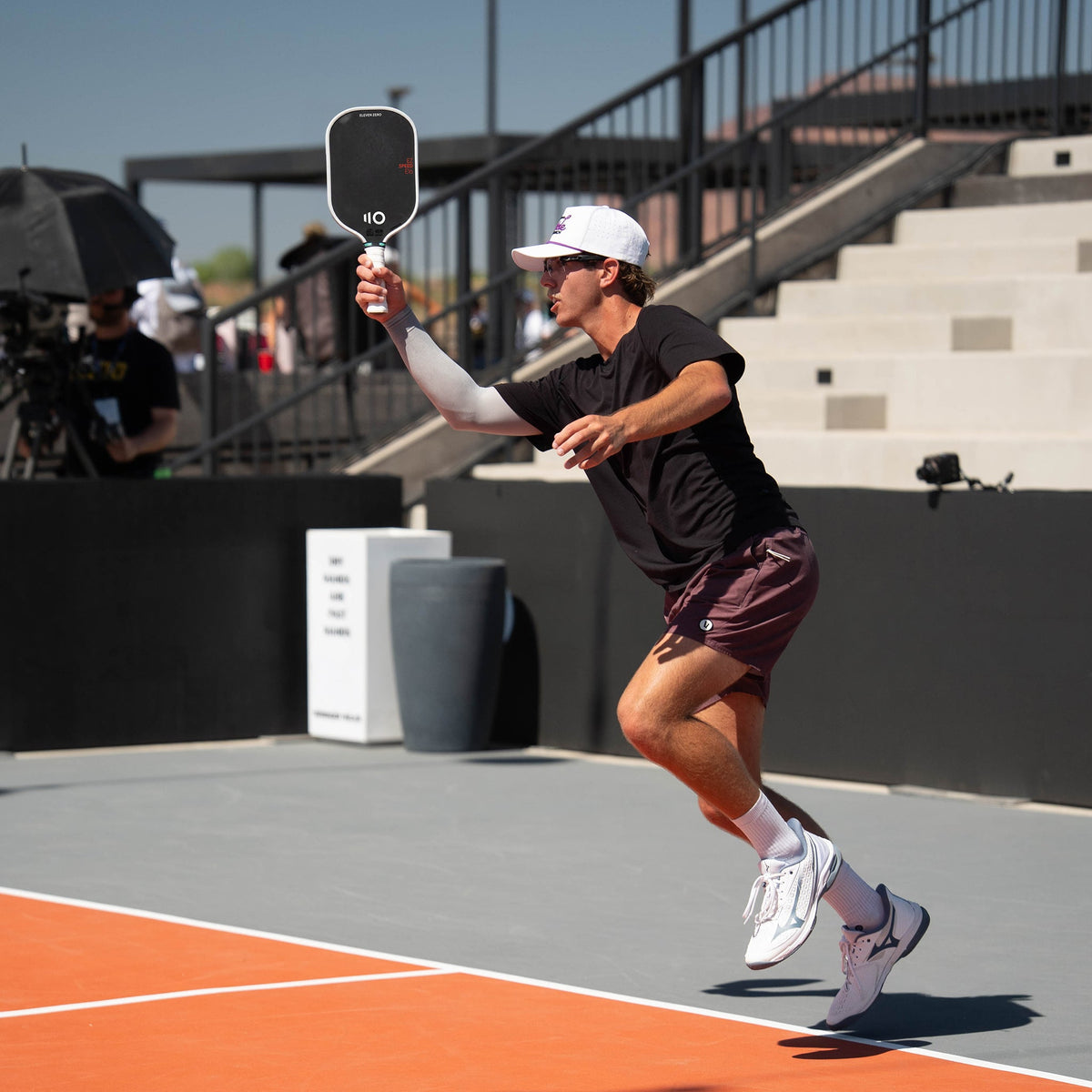
- Soft grip. 3 out of 10 on grip pressure. The softer your hands, the better your touch. A paddle with a comfortable handle helps here. The EZ Speed E14 has an elongated handle that gives you room to adjust grip pressure without cramping. Death grip = ball sails long.
- Follow through toward your target. Your paddle should finish pointing at where you want the ball to land, over the net and into the kitchen.
- Contact in front of your body. Not beside you, not behind you. Out front where you can see the paddle meet the ball.
The Trajectory
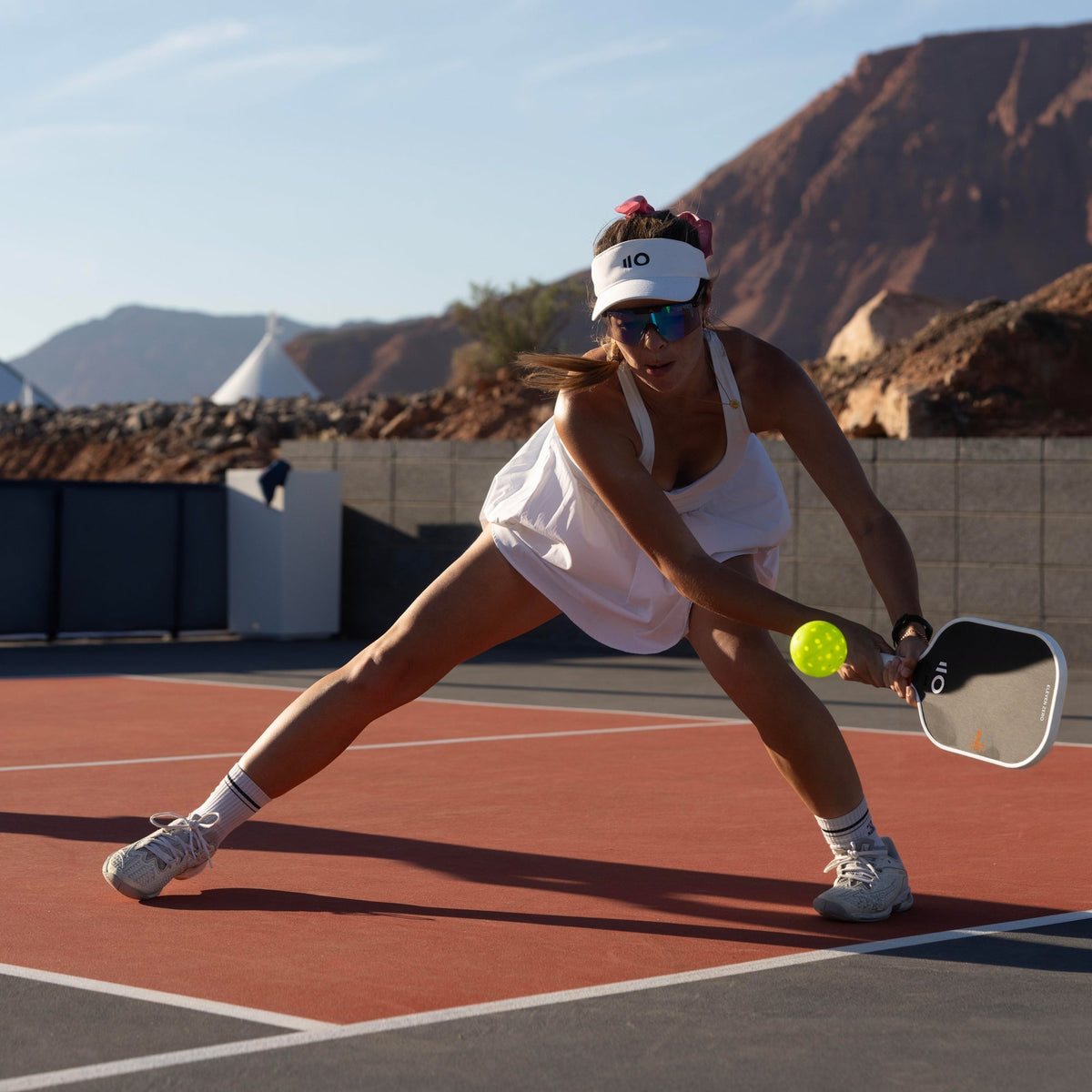
The ideal third shot drop has an arc that peaks on YOUR side of the net, then descends into the opponent's kitchen. Think of it as a rainbow that tops out before the net. Your paddle face material affects how the ball comes off the surface, which influences the arc you can generate.
Why this matters: if the ball is still rising as it crosses the net, it's attackable. If it's already on its way down, the opponent has to hit up, which is exactly what you want.
The apex of the arc should be roughly 2-4 feet above the net, on your side. The ball then drops over and lands soft in the kitchen. Getting this arc right is the entire challenge.
The Most Common Mistakes
1. Hitting too hard
The #1 error. You're nervous, the ball is coming fast, and you swing with too much force. The drop sails long or bounces high, free point for the opponent.
Fix: Think "less." Whatever power you think you need, use half of it. You're lifting the ball 30 feet with an arc. That takes almost no force.
2. Flat trajectory
A line drive that barely clears the net isn't a drop, it's a gift. Even if it lands in the kitchen, it arrives with pace that your opponent can redirect.
Fix: Aim higher over the net. Yes, higher. A ball that arcs 3-4 feet above the net and drops into the kitchen is far safer than one that skims the tape.
3. Aiming at the kitchen line
The kitchen line is 7 feet from the net. That's a lot of room for the ball to sit up. Aim for the middle of the kitchen, or better yet, at your opponent's feet right at the NVZ line, where the ball bounces into their body.
Fix: Target the space between the net and the kitchen line, not the line itself.
4. Dropping when you should drive
Short, high returns are attack balls. If you drop a ball that's sitting at shoulder height inside the baseline, you're wasting an opportunity.
Fix: Read the return. High and short = drive. Deep and low = drop.
5. Not moving forward after the drop
The drop isn't the end, it's the beginning. A good drop buys you 1-2 seconds to move toward the kitchen line. If you hit the drop and stay at the baseline, you've wasted it.
Fix: Hit and move. Immediately. Your first step forward should happen before the ball crosses the net.
Drills That Actually Work
The 100-Drop Challenge
Stand at the baseline. Have a partner feed you balls from the kitchen line. Hit 100 drops. Count how many land in the kitchen. Your goal: 70%+ consistently. Most intermediate players start around 40-50%.
Drop and Move
Same setup, but after each drop, take 3-4 steps forward. Hit a fifth shot (probably another drop or a volley), then reset. This trains the transition game, not just the shot in isolation.
Pressure Drops
Play points starting from the baseline against opponents already at the kitchen line. The ONLY way you can advance is by successfully dropping. If you drive, you stay back. This forces you to develop the drop under real game conditions.
Cross-Court Drops
Practice drops cross-court exclusively. Cross-court drops travel over the lowest part of the net and have more margin for error. If you can reliably land cross-court drops, straight-ahead drops become easier by comparison.

The Mental Game
The third shot drop requires more mental discipline than any other shot in pickleball. You're standing 30+ feet from the net. Two opponents are staring you down from the kitchen line. Every instinct screams "hit it hard."
And you have to do the opposite. You have to hit soft. You have to trust the arc. You have to commit to a shot that feels passive but is actually the most strategic play available.
That trust comes from repetition. Hit a thousand drops in practice and your hands will know what to do when the pressure is on. There's no shortcut, just reps.
The Bottom Line
The third shot drop won't make you look cool. It won't show up on highlight reels. Nobody will say "nice drop" with the same energy as "nice slam." But it will win you more games than any other single shot in your repertoire.
Master the drop. Move to the kitchen. Control the net. Win the point. That's the formula, and the third shot is where it starts.
Ready to level up? Shop the EZ Speed line, designed by PPA touring pro Camila Zilveti for serious players. Browse our full catalog.
Share:
Best Pickleball Paddles for Intermediate Players in 2026: What Actually Matters
How to Generate More Spin in Pickleball: Techniques, Paddles & Drills (2026)