


By Brian Kerr, Co-Founder & Product Engineer at Eleven Zero Sports
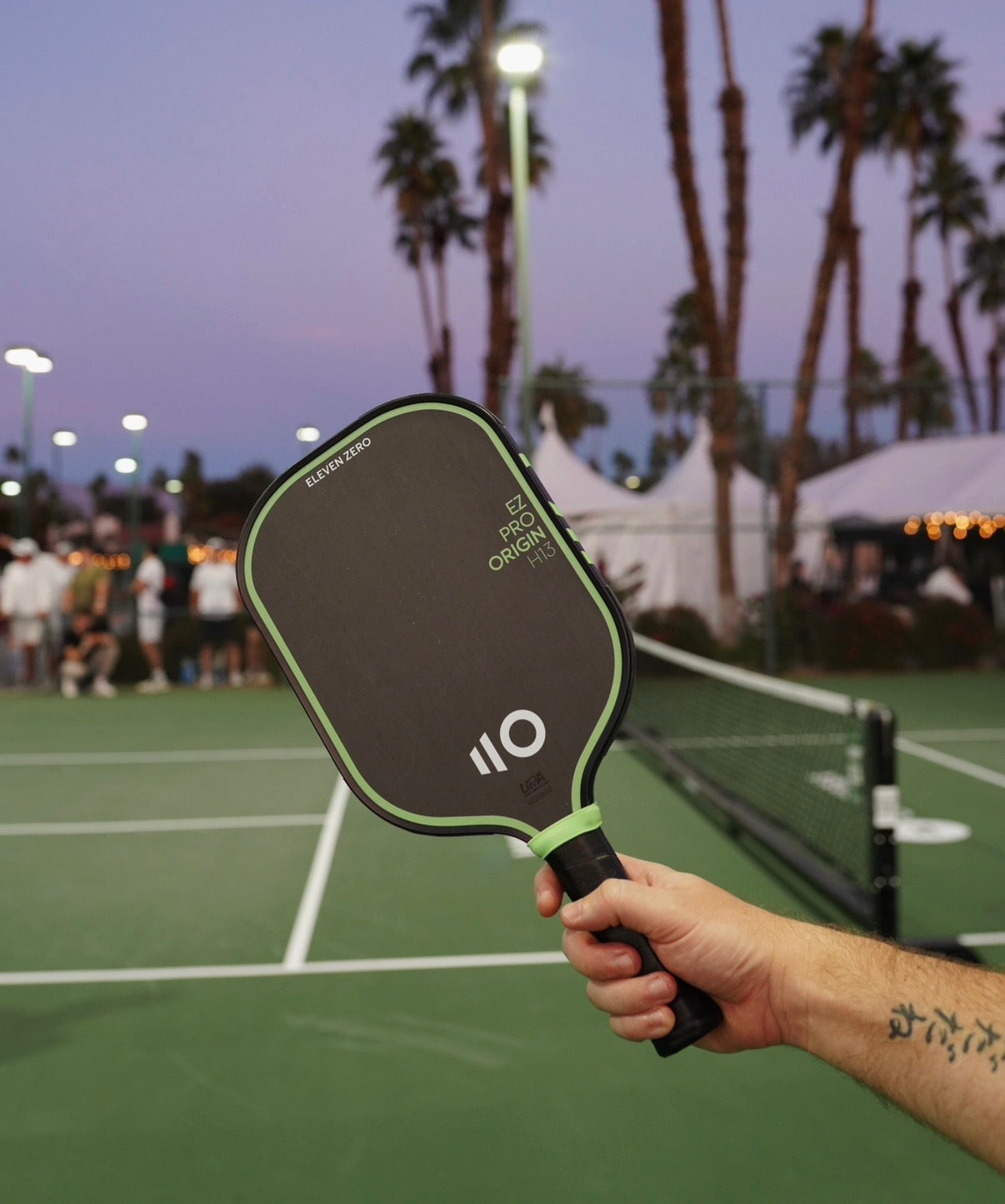
We get asked a lot about how we design paddles. What goes into the decisions. Why we pick one material over another. With the Pro Origin H13, there's a real story worth telling, because this paddle exists to solve a problem that's been bugging me for a long time.
The problem: power paddles that hide the ball from you
Here's what I kept running into, both as a player and as someone designing paddles. The power category is full of stiff, dead-feeling paddles. They hit hard. They look great on paper. But when you play with them, you lose something that matters more than raw pop: feedback.
A stiff paddle masks what's actually happening at contact. You swing, the ball leaves, and whether you caught it clean or clipped the edge, the sensation is roughly the same. That's fine if you're already a finished player. But most of us aren't. Most of us are still building our game, still refining our mechanics, still learning what a good contact feels like versus a bad one.
I wanted to build a paddle that gives you power without taking away that information. A paddle that talks back to you. Power without punishment.
Why flex is the whole point
The H13 is built around what we call a flex-profile design. That's not marketing language. It's a specific engineering choice about how the core and face interact during a shot.
When the ball hits the face of the H13, the core compresses evenly across the contact zone. That even compression means longer dwell time. The ball sits on the face a fraction of a second longer than it would on a rigid paddle. And in that fraction of a second, two things happen: you get more control over where the ball goes, and you get more tactile feedback through the handle.
When you mishit, you feel it. When you catch it right on the sweet spot, you feel that too. Over hundreds of reps, that feedback loop trains your hands faster than any stiff paddle can. Stiff paddles flatten the signal. Flex paddles amplify it.
Camila was hitting with a prototype during her PPA training block, and her comment was simple: "I can feel everything." That's exactly what we were going for.
The core decision
The core of the H13 is a honeycomb and carbon fiber composite. We went with 8mm cell geometry instead of the industry-standard 6mm. That's a deliberate choice, not a default.
The 8mm cell geometry lets the core compress evenly across the whole face. That even compression is what reduces dead zones and opens up a bigger sweet spot. It also gives you longer dwell and immediate feedback on contact. The 6mm cells that most manufacturers use create a tighter, stiffer honeycomb. That's great for paddles where you want maximum rigidity. For the H13, rigidity was the opposite of what we needed.
This wasn't the cheapest option. We could have sourced overseas honeycomb at a lower cost per unit. But when your entire paddle philosophy depends on how the core flexes, consistency matters. Every cell needs to behave the same way. A cheap core with irregular cell walls would undermine everything we designed around.
The face is a unidirectional soft matte carbon. That matte texture is part of the layup, not an applied grit, so it won't wear off in three weeks, and it adds dwell and spin at contact. We also added fiberglass reinforcement at the throat to reduce twisting on off-center hits, and hard handle pallets for stability through the grip.
Intentionally underweight (and why that's a feature)
The H13 ships at 7.8 oz. If you've shopped for paddles before, you know that's lighter than what most players take into competitive play. Tournament-ready paddles typically run 8.0 to 8.5 oz.
We did this on purpose.
Every player's swing is different. Your swing speed, your grip pressure, where you generate power, how you transition from backhand to forehand. All of that affects where weight needs to sit on your paddle. A paddle that ships at 8.3 oz doesn't give you much room to customize. You're stuck with someone else's weight distribution.
The H13's hairpin frame is built for customization. At 7.8 oz stock, you have room to add tungsten tape exactly where your swing needs it. Head-heavy for more power on drives. Handle-heavy for faster hands at the kitchen. Balanced for an all-court game. The paddle adapts to you, not the other way around.
Our testing showed the H13 plays best between 8.0 and 8.5 oz with tungsten tape added. It's a 13mm thickness and a 16.2" x 7.8" hybrid shape. Those numbers shift as you add weight, which is the point. You're building your paddle, not just buying one.
Honeycomb, not thermoformed (and that's the point)
If you follow Eleven Zero, you know our EZ Speed line is thermoformed. We believe in thermoforming for those designs. It's a power and energy-transfer construction method, and it's excellent for paddles built around drive.
The H13 takes a different approach. It uses a honeycomb core and a flex-profile build, and that's not a cost-cutting move or a compromise. It's a fundamentally different design philosophy.
Thermoforming fuses the face, core, and frame into a single stiff structure that's tuned for energy transfer. For the H13, we wanted the face to respond independently from the frame. We wanted the core to compress without fighting against a locked-in shell. We wanted more dwell, more flex, more feel.
So we used a honeycomb core and a layup that lets each component do its job. The face flexes. The core compresses. The fiberglass throat reinforcement keeps the frame stable. Everything works together, but nothing is locked rigid. It's a different tool than a stiff power paddle, built for feel and feedback rather than pure force.
Different tools for different jobs. If you want thermoformed power, we make those paddles too. The H13 is for players who want something else.
Who this paddle is for
The H13 is for two kinds of players.
First: players moving up from their first serious paddle. You've been playing for a year or two. You've outgrown the starter paddle. You want more power, but you don't want to lose the feel that's helping you improve. The H13 gives you both, and the customization options mean it grows with your game instead of locking you into one setup.
Second: experienced players who are tired of stiff power paddles that punish mishits. You've played with the big-name thermoformed paddles. They hit hard on clean contact. But off-center? They rattle your hand, and every mishit feels the same as every other mishit. You want a paddle that tells you what happened so you can adjust. The H13 does that.
Both types of player share something: they want to feel the ball. They want feedback. They want a paddle that's a training partner, not just a piece of equipment.
The details and what's next
A few things to know. The H13 uses a honeycomb and carbon fiber core with a unidirectional soft matte carbon face, and final assembly in China. It's UPA-A certified, so check your local tournament requirements if certification matters to you. We're transparent about that because you deserve to know before you buy.
The Pro Origin H13 is $179.95. If you want a paddle that talks back to you, that adapts to your swing, and that's built around feel instead of just force, this is what we made.


Share:
Kitchen Line Strategy: How to Win the Dink Battle
How to Replace Your Pickleball Paddle Overgrip (And Why You Should)